Effective this morning, XPLANE is joining the Dachis Group, the world’s leading social business consultancy, as a wholly-owned subsidiary. I want to take a moment to share what this means for XPLANE and our customers, and why I am excited about it.
Initially, the only change employees and customers will notice is the Dachis Group logo on our home page. XPLANE will continue to serve customers just as we have for the past 15 years. If you’re a customer, partner or employee, you probably won’t notice any differences at first. But joining the Dachis Group is a strategic move for our company and for our customers. Here’s why I am excited about it:
First, Dachis Group is backed by Austin Ventures to the tune of $50 million. This gives us the financial ability to scale so we can serve a growing and global customer base. The combined Dachis Group now has over 100 employees, with offices in seven cities and five countries.
Second, the Dachis Group is scooping up the best and brightest teams in social technology. Recent acquisitions include Hinchcliffe & Company, headed by Enterprise 2.0 guru Dion Hinchcliffe; Headshift, a social-business technology and strategy consultancy; and the 2.0 Adoption Council, a peer group of managers in large enterprises that are pioneering the adoption of Web 2.0 technologies and practices.
Third, the Dachis vision for Social Business Design is a sound and compelling one. They understand that social business is a fundamental shift not only in technology but in society and the fundamental ways that we do our work. Their vision for business transformation involves all aspects of business, from employees to partners to customers, from organizational culture to business systems to technology.
Fourth, CEO Jeff Dachis has a proven track record growing best-of breed internet consultancies. As co-founder of Razorfish, he grew that company into a global firm which successfully navigated the dot-bomb crisis and eventually its parent company sold to Microsoft for $6 billion. Now owned by Publicis, Razorfish is one of the world’s largest interactive agencies, with more than 2,000 employees and offices all over the world.
As a part of the Dachis group, XPLANE will be better financed and more strategically positioned than we have been in the past, so we’ll be able to grow faster and serve our customers better.
This move is also strategic for our offerings: As a visual thinking company, XPLANE has the ability to help our customers transform their businesses. Our customers will attest to that. Like any technology, visual thinking, and the clarity it provides, can accelerate growth and offer strategic advantage. But visual thinking, although powerful, is less imperative than social business.
For the last 15 years, the biggest thing that businesses needed to figure out was how to transition onto the web and into an internet economy. This was a disruptive change, a huge shift. Many companies perished and many fortunes were made. The risks and rewards were, and will continue to be, great.
In the next 15 years, the most significant change that business will undertake is the transition to social technologies. In ten years you’ll be a social business, or you’ll be out of business.
Why do I say that? It's pretty simple. All you need to do is ask yourself one question: Is word-of-mouth important to your business success? If so, you need to begin the transformation to being a social business.
There are a few things I can say confidently; things in business we can be certain about:
- Business success has always relied heavily on social networks and networking. Always has, always will.
- If you are early to recognize the potential of new technologies and build them into your business, you will gain competitive advantage and potentially claim new markets .
- The core of social technologies is that they make word-of-mouth conversations tangible, sharable and trackable. Do you think this kind of technology might drive real business results? I do. Word-of-mouth is the most trusted source of information, wisdom, references and referrals.
- You can’t opt out of social business, any more than you could opt out of the internet. You are part of the word-of-mouth conversation whether you participate or not. This means the transition to social is imperative.
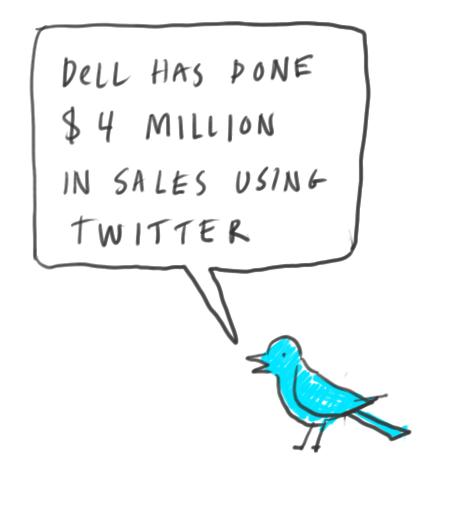
We have seen over and over that when it comes to disruptive technologies, the initial trends are set by individuals and small teams, and are later adopted by the bigger companies. Microcomputers, blogs, email, file-sharing, web services and voice-over-IP were all pioneered by small teams. Today, Twitter and Facebook are setting the trends. Individuals and small teams are using these tools now, and the corporate world is certain to follow.
But adoption of new technologies is not simple or easy, and the bigger the enterprise the harder it gets. Here are a few of the opportunities and threats you will have to navigate if you want to socially calibrate your business:
Customer service
Opportunity: If you’re a social business, you will respond faster to customer issues and thereby improve your customer relationships. You’ll have better product and service quality because you’ll have better feedback loops. You will simply understand your customers better.
Threat: If you opt out of social business, your competition will know more about your customer’s complaints than you do. They will swoop in and steal your customers before you know what hit you. They’ll be in a position to steer the all-important word-of-mouth conversation away from you and toward themselves. You’ll respond to customer concerns too slowly or too late.
Public relations
Opportunity: You’ll be continuously aware of the word-of-mouth conversation and how it affects you. Your social channels will serve as an early-warning system, enabling you to be more proactive and put out more fires before they start.
Threat: You’ll be surprised by a new trend because you’re not monitoring the social sphere. By the time you notice a PR fire it’ll be raging out of control and you’ll be operating in crisis mode.
Markets and marketing
Opportunity: You’ll be tracking the trend-setters and influencers and you’ll know how their ideas spread through the social network. You’ll know who generates recommendations and referrals – who drives the real growth in emerging markets – and you’ll know how they do it.
Threat: You’ll watch competitors or new entrants steal away your customers, and by the time you figure out what’s going on it’ll be too late.
Intellectual capital
Opportunity: Finally there’s a way to deliver on the promise of knowledge management – a way to capture the wisdom, ideas and genius of your employees – the information that’s contained in the heads of the people who walk out the door every day. I’m talking about the information that makes your business effective, even though it’s not written down in any book, manual or report. If you opt in to social business you’ll know who the experts are, and their peers will know how to find them and tap their expertise. You’ll know how information really flows through your organization – not the fiction of the org chart but the real social network that keeps things going. You’ll be able to cut meeting time in half by sharing routine information more effectively.
Threat: Your best and most brilliant employees will walk out the door and you won’t even know the value that you are losing. They will want to further their careers, so they’ll head for a more networked company where they can be more effective.
Is social media a fad? I’ll let this video answer that question:
Social business is like the internet or any other disruptive technology. The question isn't whether to do it or not: the question is whether you're going to be early or late. We decided to be early, and there's no turning back.
Keep in touch! Sign up to get updates and occasional emails from me.







"Unfortunately [Dave Gray] illustrated his engaging talk with a glorification of the AK47 as a ‘powerful tool of change’. His agnostic design philosophy hides an ethical ambivalence and repositions designers as hired hands of industry who do whatever is needed – even weapons of mass destruction. Can’t we find ethical examples which enable people, but don’t kill?"
Jan missed the point of my AK-47 example. There's nothing agnostic about my design philosophy -- a philosophy I share with Mikhail Kalashnikov, the designer of the AK-47. The design philosophy is this:
Don't design for a perfect world, because the world isn't perfect. Design simple things that are rugged, reliable, simple and easy to use; things that work even when conditions are chaotic; things that work even when they are mostly broken.
The AK-47 is a successful weapon because it was designed to work when the world is falling apart around you. When an AK-47 is wet, when it is clogged with mud, sand or snow, it will still work, in conditions where many more precise and accurate weapons will fail.
That's not an agnostic design philosophy, it's a philosophy that is deeply rooted in fundamentals. It's a philosophy that requires a designer to prize simplicity and exhibit strength of purpose; that emphasizes ease-of-use and reliability over feature-richness and perfection.
Now, we can also argue about ethical ambivalence -- whether it's ethical to design a weapon. This is an age-old and probably unresolvable argument. The intent of my talk was to demonstrate the design philosophy in a memorable and dramatic way by telling the true story of one designer.
Mikhail Kalashnikov designed the AK-47 because his homeland had been invaded by an enemy with superior weapons. He wasn't a "hired hand of an industry, doing whatever was needed." He was a tank mechanic who saw fellow soldiers and civilians gunned down and wanted to ensure that it would never happen again.
If Kalashnikov had lived in the west he would be a rich man today (Yes, he’s still alive, about 90 years old). But he grew up in a communist state, so he’s now a national hero who lives on a government pension.
Mikhail Kalashnikov is on record as saying that he would have preferred to have designed something more useful, for example, a lawn mower. But his country was invaded, he was severely wounded and in his hospital bed, his thoughts turned to weaponry. Can we really blame him? It's hard to see him as a profit-seeker or a "hired hand of industry."
He designed a weapon with the intention of repelling invaders, and in fact the AK-47 has to be seen as one of the most successful weapons of all time in this regard. Since he designed it in 1947, Kalashnikov’s weapon has enabled other people to defend their homelands from invaders, even superpowers: It helped the Vietcong drive American troops out of Vietnam, and it helped the Mujahideen drive the Soviet Union out of Afghanistan.
Are there other examples I could have used to make my point? I am sure there are. But as a person who has spoken at many conferences, and also as a person who has sat through many polite-but-boring talks, I choose to make my points as dramatically, engagingly and entertainingly as possible. As a history buff, the story of Mikhail Kalashnikov captivated me, and I was sure it would do the same for others if I could tell it compellingly. When I want to make an important point, I do it with drama, because that’s what people remember. There’s a reason that war movies are more popular than design documentaries.
I would rather stir up a bit of controversy than subject an audience to slow, agonizing death with PowerPoint bullet points. And if you are speaking and I am in the audience, I hope you will do the same for me.