31 August 2005

When is it okay to be angry?

Like many people I have struggled over many years to learn how to be a good manager. If you have ever managed a team, you know how hard it can be. One day, in a moment of sheer frustration, I asked a wise man “When is it okay to be angry?”

His answer: “When it’s about facts.”

Keep in touch! Sign up to get updates and occasional emails from me.

Are you one of us?

Pop quiz! Answer TRUE or FALSE to each of the questions below:

  1. You navigate. When confronted by a challenging, complex or confusing situation, you find a way. A brick wall doesn’t stop you because you have so many options: you can go over it, under it, around it or through it. And you do.

  2. You love puzzles. The questions that don’t have predefined answers are the ones you find most interesting. And you know that you can find the answer if you put your mind to it.

  3. You draw. You can’t explain a concept without scribbling. And you’re pretty damn good at it.

  4. You love language. You’d prefer a mosquito bite to a misspelled word or awkwardly constructed sentence.

  5. You edit. You won’t use two words when one will do.

  6. You love clarity.

  7. You love design. You breathe easier when there’s adequate white space. You care about typography. Your information hierarchies are clear and distinct. You expect good thinking to lie behind every design decision, and are vocal in your criticism when it doesn’t.

  8. You like working with people. You work not just for yourself but for a higher cause which serves others. You enjoy collaboration and working with a team.

  9. You need to be the best. Second place won’t do. You hold yourself to the highest standards, and you won’t play on a team that doesn’t share that drive.

  10. You take work home with you. You work on weekends, not because you have to but because you love what you do. Not everyone in your life understands.

If you can answer yes to all ten questions, you might be an XPLANER. We want to talk to you. Right now our creative team is desperately seeking illustrators, information designers, and concept developers/storyboard artists.

And if you know somebody who fits the mold (you know who they are!) please forward this to them. We are on a mission, and nothing but the best will do.

XPLANE conducts Visual Thinking School nearly every Thursday in our St. Louis-based headquarters. If you share our vision and are going to be in town, drop us a line or comment on this post. We’d love to have you join us.

Thanks!

Dave


Keep in touch! Sign up to get updates and occasional emails from me.

30 August 2005

Nobody looks at the org chart


The org chart is a useful tool: it’s a visual way to represent the chain of command and in large, complex organizations it can be helpful. The bigger the company, the more it can help you navigate.

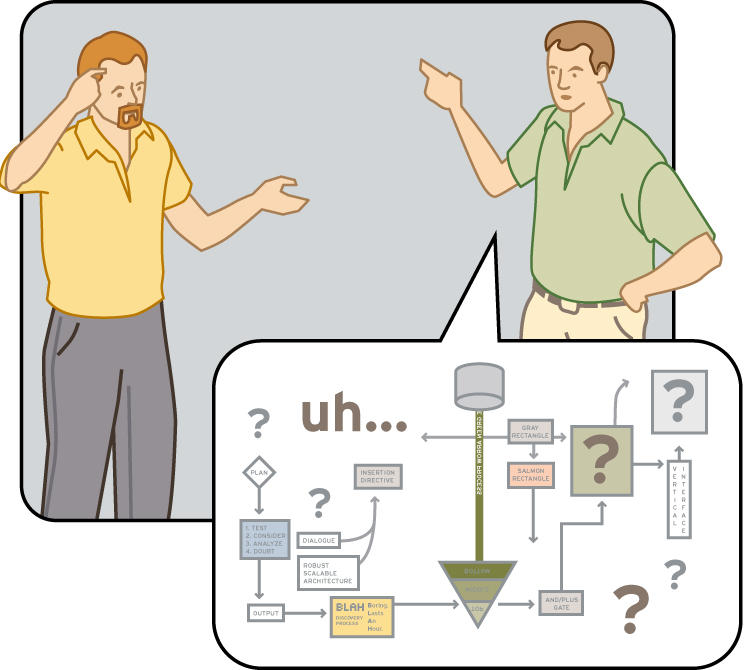
But most of the time, nobody ever looks at it the org chart. When it comes to their daily lives, the org chart is irrelevant.

It’s the same with flow charts and process maps: they’re helpful to define things; as thinking and planning tools; but far too often, people try to use them to communicate.

Communication is a task for which many charts and process maps are woefully unsuited.

People don’t like to think of their role in the organization as a name in a box, lost in rows and columns of identical boxes. They don’t like to think of their jobs as diamonds, boxes, lines and arrows.

People think of their roles as important links in a chain that delivers value to customers. They think of their jobs as interactions between people that help drive that value: teamwork, decisions, action, results.

Org charts and process maps can be clear if people invest the time to read them, but most of the time they don’t, because the very format the information takes is dehumanizing.

Next time you want to convey a process, or discuss people’s roles and accountabilities, think about visualizing what’s really important to them instead of drawing boxes and lines. Your people will appreciate it, you’ll see more “light bulbs” go on, and in the end you’ll see better results.

Keep in touch! Sign up to get updates and occasional emails from me.

Master the art of asking

If you want to be an effective communicator, you need more than just communication skills: you need to have something meaningful to say. You can start by

1. Collecting good information, and

2. Taking the extra time and energy to make it relevant to others.

You can do both at once by learning to ask good questions. The benefit of collecting information this way is that you automatically get deeper context than you would ever get from other kinds of research; you learn what people really care about.

Questions can be broadly categorized into two types:

1. Open questions provoke dialogue. They begin with “What” “Who,” “Where,” “Why” or “How.” Open questions can never be answered “yes” or “no.” Examples:

How do you go about doing this today?”
What area do you see as needing the most improvement?”
Who will make the final decision?”
Where are the biggest problem areas?”
Why hasn’t this been done before?”

2. Closed questions confirm your understanding or seek commitment. They begin with do, so, is, are, if, can will, would, should, or could. Closed questions can only be answered “yes” or “no.”

Examples of closed questions that confirm understanding:
Do you find this acceptable?”
So you think the situation is deteriorating, is that right?”
Is this common?”
Are you saying that these kinds of initiatives have failed in the past?”

Examples of closed questions that seek a commitment:
If I guaranteed immediate delivery, would you buy today?”
Can you think of a reason not to do this?”
Will you decide by Tuesday?”
Would you like this today?”
Should we talk to your boss?”
Could we call him now?”

Ask good questions, for good reasons.

Adapted from Selling to the VP of NO by Dave Gray

Keep in touch! Sign up to get updates and occasional emails from me.

What color is your tone?

Tone is one of those interesting and ephemeral words that refer to sound, environment, voice, color and emotion, both in a tangible and literary sense. Something’s tone is what makes it unique or distinctive; it is a physically recognizable “something” that uniquely tags a person, place or thing:
  • Sound: The bell's tone announced the arrival of the Keaggy

  • Environment: The tone of the room changed noticeably as he entered

  • Voice: As he took the podium, his voice took on an anxious tone

  • Color: He looked up at the sky, which had assumed a torpid tone of gray

  • Emotion: The general tone was one of nervous energy

Let’s talk about your emotional tone for a second. Any time you interact with another person, whether it’s by phone, by email, in meetings or in person, it’s important to know: what color is your tone?

You could think of your tone as living somewhere on a color spectrum.

VIBGYOR is a way to remember the order of the color spectrum, which is important in this case (When I was in fifth grade, a science teacher named Mr. Holt (Wish I had a link, that guy was a character) helped me memorize the color spectrum using the acronymn VIBGYOR, which stands for Violet, Indigo, Blue, Green, Yellow, Orange, Red).

At one extreme end of the spectrum, which we could call deep purple, is low energy, where you will find a tone of isolation, which might be thoughtful and contemplative, or could also be sad and lonely. At the other end, which we could term hot red,you will find a high-energy, volatile tone, which could be either angry or highly creative.

How do you gauge the tone of a conversation? Trust your instincts. What is the other person’s facial expression or tone of voice? Note the surroundings. Are they appropriate, or conducive to what you want from the interaction? If you are unsure, don’t be afraid to ask.

Generally, good communication lives in the “middle tones” of green and yellow. Green is a color of nurturing and growth, and yellow is a color that denotes warmth, happiness and contentment. But more important than your tone is the rapport between you and the person you are communicating with.

If you are both red, you might find a highly productive and creative dynamic. Both blue? You might find it valuable to sit together, but work independently.

Start matching your tone to others’ and see how it changes the degree to which you can connect with others.

As always, I very much want to hear your thoughts – and especially the tone of your thoughts!

Keep in touch! Sign up to get updates and occasional emails from me.

29 August 2005

The leader's job

The most often forgotten part [of defining progress] is the daily guidance of a team. It’s the leader’s job to continually reflect back to individuals how their work fits into the goals. In every meeting, discussion and e-mail the leader must reinforce, remind, cajole, and motivate people’s work towards whatever the collective goals are, flagging work that is questionable and activities that are unnecessary.

From Work vs. progress by Scott Berkun, author of The Art of Project Management. Thanks to bblog for sharing.

Keep in touch! Sign up to get updates and occasional emails from me.

28 August 2005

The new PR

If you’re a communication professional, there’s no doubt that the media landscape is shifting under your feet – some would say it’s turning to quicksand, where no footing or approach feels secure. Are press releases dead? Will blogs soon replace them? For dialogue and debate on this and more, check out the New PR/Wiki.
It looks like a fantastic resource for executives, PR professionals, and anyone else who is interested in the points where business, new media and public discourse intersect
Here’s the site’s mission:
  • A repository of relevant information about how the PR practice is changing

  • A collaboration tool for PR professionals and people interested in the practice of public relations

  • An open space where anyone can ask questions, post ideas, or start a project
As always, I want your feedback to help me keep this blog useful and relevant. Please let me know what you think.

Keep in touch! Sign up to get updates and occasional emails from me.

27 August 2005

Paintings from my personal collection


Inspired by Flickr and the new Google sidebar, I decided to publish selections from my art collection. These are personal works of art; primarily still lives and landscapes, and this is the first time they have been published in any form. If you like the one above, you can see more here.

Also, if you download the new Google sidebar, you can get my artwork delivered directly to your desktop. Here’s how:
  1. Go to the options menu

  2. Click the tab marked “Photos online”

  3. In the “Add URL” field, paste the following link: http://www.flickr.com/services/feeds/photos_public.gne?id=38075047@N00&format=atom_03

  4. Click “Add URL”

Enjoy!

Keep in touch! Sign up to get updates and occasional emails from me.

Google's master plan

“To some extent, Google is bringing back the architecture of the mainframe to render Microsoft obsolete. In the future, all computing devices, whether it be the PC, mobile phone, TV, etc., will simply be terminals that “plug-in” to Google’s massive server grid and application services.”

— By Robert Young, guest-posting on Om Malik’s Broadband Blog.

Read more about Google’s master plan to dominate your desktop.

Keep in touch! Sign up to get updates and occasional emails from me.

26 August 2005

Map shock

From my friend Cliff Atkinson, presentation expert and author of Beyond Bullet Points:

“Have you ever been so confused by the complexity of a map, chart or diagram, that you didn't know where to begin to make sense of it?

If so, you may be a victim of "map shock" or "visual shock", according to Donald F. Dansereau, Ph.D., of Texas Christian University. Don is Professor of Psychology and Senior Research Scientist in the Institute of Behavioral Research at TCU, and teaches graduate statistics and cognitive psychology.”

Read on in “Map shock.”

Keep in touch! Sign up to get updates and occasional emails from me.

How to handle an emotional conversation

How do you have a productive conversation with someone who is upset or otherwise emotional? Well, the short answer is: you don’t. But you can make the best of the situation and often turn it around if you can recognize the dynamics that are at work.

Emotional conversations don’t just bubble up out of nowhere. By the time someone has gotten to the point of having an emotional conversation with you, there is probably a history there, even if you are not aware of it. The history could take several forms:
  • It could be that they were talking to someone else in your organization and they just got “escalated” to you.

  • It could also be that you were not actively listening to them; that is, you may have been paying attention to their words but not their tone of voice or body language.

  • It could also be that you unintentionally (or intentionally!) triggered an emotional reaction that has nothing to do with you but could be buried deep in the other person’s psyche or emotional history.

If people worked like web browsers (thank god they don’t!) you could just check the “history” button or look at the log files and figure it out. Since people are biological beings (thank god they are!), you need to take a more biological approach.

It may have taken quite a while before their emotion reached the level that it is visible to you. The more controlled the person, the more startling it may be when they “burst out” at you. Warning: I am not a psychiatrist; my observations come from my practical experience running a business and managing people. That said, here are a few tips for getting through an emotional conversation:
  1. Don’t defend yourself. People who are emotional usually feel that their point of view is rational and justifiable, and you won’t get anywhere telling them otherwise.

  2. Verbally recognize the feelings at play. You don’t have to think the emotions are justified or find the conclusions logical. Simply try to confirm that you have recognized the proper emotion and let the person know that the emotion, at least, is legitimate. For example, “It sounds to me like you are feeling quite angry about this.”

  3. Try to understand and play back the “emotional history.” Ask questions to help you understand how the person got to this point. Usually this won’t be difficult because they are probably burning to tell you the story of how they were wounded or offended.

  4. Don’t feel that you need to solve the problem immediately. If you can solve the problem instantaneously, great. If you need time to think about it, or need to gather more information, tell the person that you understand the importance of the issue, and you need some time to think about it/get more information.

  5. Follow up. If you don’t solve the problem immediately, make a promise to follow up at a later time with resolution. Be specific, as in “I will get back to you by the end of the day.” Then be sure to make good on your promise.

  6. Above all, don’t get emotional yourself. If you find yourself going there, take a deep breath and remove yourself from the situation as diplomatically as you can.*

*There are some exceptions to this one. Sometimes a conversation that is emotional on both sides needs to continue, especially if it is with someone you know well. If you sense that you may be nearing an important emotional breakthrough, keep going and follow your instincts. Sometimes an emotional conversation is just what it takes to strengthen a meaningful bond between two people.

Keep in touch! Sign up to get updates and occasional emails from me.

"You're the one who's paranoid"

Here is an actual exchange of words I heard yesterday. It was so bizarre that it must be shared:

“You guys are so paranoid you take a simple question as an insult!”

“You’re the one who’s paranoid.”

“About what?”

“About us being paranoid.”

Can you unravel that one?

Keep in touch! Sign up to get updates and occasional emails from me.

The craftsman-to-manager paradox

Do any of these things sound familiar?

1) You do work that your employees should be doing because “It’s easier to do it myself than hand it off"?

2) You work long hours, getting in early and staying late

3) Your team lacks morale, or seems stressed out most of the time, or both!

You may be suffering from the craftsman-to-manager paradox. Here’s how it works:

If you are a craftsman, you were probably promoted because you are highly productive. Most likely you are productive for a few reasons:

  • You manage your time effectively

  • You require minimal supervision

  • You are reliable

  • You take pride in a job well done

Here’s the paradox: You meet the above criteria because you are a self-reliant perfectionist: your philosophy might be summarized as “Do it right the first time” and “If you want it done right, do it yourself.”

As you move into management, the very things that made you effective as a craftsman are now deadly threats to your success as a manager. Your independence and self-reliance, which was an asset, is now a liability.

As a manager you need to change your focus, from being productive to making other people productive, which requires a wholly new set of skills. You were promoted because of your skills, and now you need to stop using them and start transferring them to others.

And that’s the paradox: To be successful in your new role, you must turn your entire philosophy inside-out. You need to stop doing things and start managing things, which is counter-intuitive and takes a leap of faith. That’s right, a leap of faith.

Sounds like religion? You bet. It sounds like religion because it is religion. Here are the ten communication commandments for managers:


  1. Make your expectations crystal clear. Leave no room for interpretation. WHO will do WHAT by WHEN?

  2. Listen actively. What is the person saying? What is their tone of voice saying? What is their body language saying? Pay attention.

  3. Be observant and proactive. Watch what’s going on around you. MBWA (Manage by walking around). Learn to anticipate problems and address them before they are problems.

  4. Master the art of asking. Good questions help you diagnose root causes and understand underlying dynamics, so you can solve the problem instead of trying to fix a symptom.

  5. Teach. Every mistake is a learning opportunity. In fact, nearly every interaction you have with your team is a learning opportunity

  6. Delegate. Anything you do yourself is a wasted opportunity for someone on your team to learn something. Stay close to help if necessary, but only if they ask for it.

  7. Coach. Spend quality time with your high performers, making them better. It’s easy to forget this one and waste lots of time on the underperformers.

  8. Don’t avoid difficult conversations. As a manager it’s your job to initiate them when necessary. And never have difficult conversations by email; always do them face to face if possible, by phone if necessary.

  9. Learn how to be tough. If you’re going to set expectations, there need to be consequences if they are not met. Face it: If you’re going to be a manager you will have to fire someone sooner or later. It’s a true communication challenge and the toughest part of being a manager. When the time comes, just do it.

  10. Develop your farm teams. You’ll need a stable of people on deck, ready to come on board should you need them. Ongoing and proactive communication is key. Keep them warm.

Many thanks to Gorpik for translating this post into Spanish.

Keep in touch! Sign up to get updates and occasional emails from me.

25 August 2005

Why most business strategies fail


Many companies have brilliant strategies (some have a lot of them!), but most fail to execute them successfully. Why do brilliant strategies fail?

  1. The company bit off more than they could chew. Some strategies are simply beyond the company’s ability to execute. The company may not have the financial resources, or the right people with the right skills, to succeed.

  1. They can’t coordinate. Even if the resources and abilities are there, the strategy may fail because the company cannot successfully organize the activities of its people – think of an army with multiple divisions and columns. Each division may march and maneuver flawlessly, but if they are not aware of each other’s activities they will bump into each other and ultimately be unproductive. This is a communications breakdown – a failure to get the right information to the right place at the right time. One of the most fundamental military strategies is to disrupt the enemy’s ability to maneuver by disrupting their lines of communication. Many modern companies don’t need an enemy – their lines of communication break down all on their own, because traditional communication methods can’t handle the level of complexity that is required in the modern business world.

  1. Failure to effectively translate strategy into tactics. Even if the lines of communication are open and information flows freely, if the people who need to do the work fail to understand, the strategy will fail. Companies that do this successfully are exceedingly rare, and they tend to be phenomenally successful, even in difficult or troubled times. Examples are Dell, Southwest Airlines, and GE. One of the reasons these companies are successful is that they simplify their business strategy so that it can be clearly and easily shared with anyone in the company in a way that guides decisions about action. For example, Southwest is the only profitable airline, and it has been consistently profitable for 30 years, because the company is relentless in its focus, and because any Southwest employee, investor, or customer can tell you exactly what the company does and does not do, and why. This is because the company has made difficult strategic decisions, and honed the message over time so that everyone understands.

Bottom line: These strategies fail for one of two reasons:

  1. Executives failed to understand and fully confront their current business reality, or

  2. They failed to effectively communicate their strategy to the people who had to execute it.

Often, this type of failure is due to the differences in how executive and functional managers see the world.

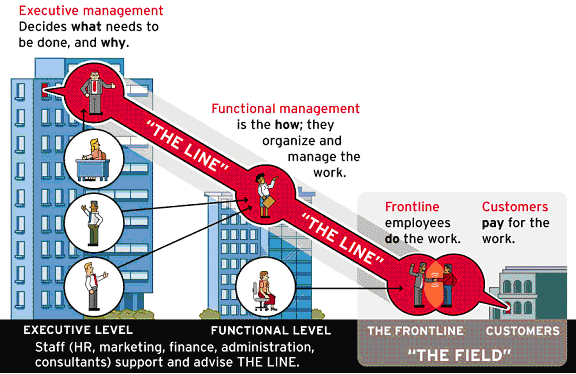
Executive managers live in the world of strategy and leadership – the what and the why. Their job is to understand their business universe and make the decisions about what needs to be done, and make sure people understand why.

Functional managers live in the world of tactics and management – the how. They organize people and materials to get things done.

The frontline deals directly with customers. They do the work.

Customers ultimately decide whether the strategy succeeds or fails. If they pay for the work, it succeeds. If not, it fails.

Because each has a different perspective, they often tend to speak and understand things differently. When they fail to understand each others’ worlds, huge rifts or understanding gaps often emerge.

For example, if senior executives understand the business context but fail to understand how functional managers will organize to execute their plans (or even whether it is possible), functional managers will end up in a no-win situation, and end up frustrated and failing.

If functional managers understand how to execute but fail to understand the why of what they are doing – how it fits into an overall strategy – they may do the wrong things – and no matter how well they execute, if they miss the larger point the company will fail.

And if the frontline doesn’t understand the what, the why and the how, they will not do the right things, and customers won’t pay. At every stage of the process – from executive to functional management, from functional management to frontline, and from frontline to customers, effective communication – sent and received – is critical for successful execution.

The line: A direct line can be drawn from executive management through customers – the line of value creation. In business this is called THE LINE – and there is a big difference in the business world between line and staff employees. The concept started in the automotive business with the assembly line. Line people live and work on THE LINE – that is, they do the activities that directly cause cash to flow into the company. The people who support and advise the line are called staff. They do things like administration, human resources, marketing and finance: things that must be done but which customers will not pay for.

The field, as discussed earlier, is where all the action happens. THE FIELD is the place where the organization comes into direct contact with the customer. The frontline workers in THE FIELD, like you, have more impact on the success or failure of the business than anyone else. If they don’t do it, it doesn’t happen.

What can we do?
XPLANE’s core philosophy can be boiled down to one simple statement: If it can be drawn, it can be done – and if it can’t be drawn, it can’t be done. This simple idea came from a couple of insights about the act of drawing.

  1. Drawing makes abstract ideas concrete. You can’t draw a picture of a strategy, plan or process without asking some important and fundamental questions about how that strategy will be executed. Simple questions, like “Who will do that?” “How will they do it?” “Who else is involved?” “You’d be surprised how often these kinds of questions get overlooked in corporate boardrooms (or maybe you wouldn’t).

  2. You need to know what to draw. Before you can make a drawing, you need to know what to put in the picture and what to leave out. “What to draw?” is a creative question. It forces you to think about and focus on what is important, because it can only be answered by addressing specifics – the most important part of the decision “what to draw” is the decision “not to draw” everything else.

  3. You need to determine how to draw it. Once the decision about “what to draw” has been made, the analytical question that must be answered is “how to draw it.” This “how” decision is equally as important as the creative “what” decision. The same thing must often be drawn quite differently, depending on the audience. For example, if you decided the right “what” to draw was “how airplanes fly,” you would draw it differently for an airline pilot than you would for a child, because they will translate it into action in different ways.

The question “what to draw?” is strategic. It can only be answered with creativity and vision. Like a corporate strategy, it requires you to select one thing from millions of possibilities. The question “how to draw it?” is tactical, because it can only be answered when you understand specifically who will do the thing, and how it will be done.

At the end of the day, a picture – in a single page – can connect the strategic with the tactical in a way no other communication possibly can. It can clearly articulate who does what, with whom, and when, in order to turn the strategy into reality. And that is surely worth at least a thousand words.

Keep in touch! Sign up to get updates and occasional emails from me.

What’s the big deal about blogging, XML and RSS?

My friend Richard Black, Technology Strategist, answers that question eloquently in his email, below, which I share with his permission. I am sharing it for two reasons:

1) It was helpful to me, and could be helpful to others who are new to blogging, and:

2) When people ask you “What’s so great about blogging/RSS?” you can send them this link and save yourself the time and trouble of explaining it.

(I made minor edits to add emphasis, and “Americanized” the spelling)

Dave,

Let me try to explain why I think RSS is so important (at the end of my story, I'll add why the BBC think it's important).

WARNING: I've told this story many times, but I've never written it down before. Welcome to my first draft.

I have a habit born from a fear. I feel uncomfortable operating, working, creating (maybe even living) without some assurance that I have some wisdom, some “anti-ignorance.” Some of my most spectacular learning opportunities (a.k.a. mistakes) were made whilst I was operating in complete ignorance. I wrote software without understanding the first thing about UNIX, I went bicycle racing without understanding about preparation, I went car racing without understanding technique, etc.

The web was made for me; a sort of modern replacement for spending hours in libraries figuring things out. At least that's how it seemed in mid-1990s. But the web rapidly became very very large. No longer could I read all the new web pages everyday. No longer could I even find all the new pages everyday. Actually, I started to have trouble finding anything on the web any more. And so, it seems, did a lot of people.

People like Dave Winer and Tim Berners-Lee recognized that the web could be improved with a simple but far reaching shift: namely, giving computers the ability to understand more about the information presented on web pages. Instead of just plain-old text, they introduced ‘smart text;’ XML-encoded text that computers understand.

So what? This turned out to be just about the smallest possible change that could produce the greatest possible effect. Maybe some of you have heard the butterfly-flaps-its-wings story from complexity science. In the space of about a year, the web has been transformed - mostly because of XML, specifically one type of XML called RSS.

What happened next?


  • Firstly: in a great many areas I'm interested in, people are aggregating and editing the ‘best of the web’ into wonderfully useful, cutting-edge sources of knowledge. My computer (well, my feed reader) automatically brings in all that is newly of interest to me (all the time). It surfs the web so I don't have to.


  • Thirdly: RSS and other forms of XML will soon ‘fix’ some huge knowledge management problems for corporations. Much corporate memory and knowledge is stored in plain-old text documents, which in turn are stored in shared (or unshared) directories. This way of storing knowledge is broken; the assets sit un-discoverable and un-read. Soon, documents will become XML-enabled, and the knowledge will become discoverable, and read.


  • Fourthly: Microsoft, Apple and others are building RSS and XML inside everything they're working on. This technology is about to become part of the everyday fabric of computing.

In short, this piece of technology has now passed the “go/no go” test for adoption. It has become so easy to use my Dad uses it.

And now, I'll let the BBC have their say on RSS:

What is RSS?

In a world heaving under the weight of billions of web pages, keeping up to date with the information you want can be a drag.

Wouldn’t it be better to have the latest news and features delivered directly to you, rather than clicking from site to site? Well now you can, thanks to a very clever service, RSS.

There is some discussion as to what RSS stands for, but the majority plump for ‘Really Simple Syndication.’ Put plainly, it allows you to identify the content you like and have it delivered directly to you.

It takes the hassle out of staying up-to-date, by showing you the very latest information that you are interested in.

Not all websites currently provide RSS, but it is growing rapidly in popularity and many others, including the Guardian, New York Times and CNN do provide it.

For more information, including details about:


Richard also shared another link with me: an article from the breaking point blog called Why we need RSS. This article made a business case for blogging, pointing out that while a small number of web surfers use RSS feeds, a high proportion of them are decision-makers, because of their need to aggregate information from a variety of sources.

Overall Richard’s summary was so compelling that I had to get started right away. I asked him: “What news reader did he prefer?” Here’s his reply:

Good question. I've tried a few, and these two are the ones that madeit into my daily routine:- Firefox with Sage extension. (you'll find Sage here -> http://sage.mozdev.org)/.- Google's new personalizable home page (http://www.google.com/ig).

Of course, being an “early majority” as opposed to an early adopter, I had to get a second opinion, so I asked my friend Evan Williams, CEO of Odeo, (formerly Google and founder of Blogger) for his opinion. Evan’s pithy response:

“i use bloglines. I like it ok.”

Now Evan is way ahead of me: he founded Blogger in 1999, and I am just getting serious about blogging now, in 2005. So generally speaking, Evan is at least six years ahead of me when it comes to technology adoption. Evan is into podcasting now; so I predict, if you are patient enough, you may see a podcast from me by about 2011.

So, if Evan says bloglines is ok I’d say it’s a good bet.

By the way, if you like audio, check out Josh Minton's one-minute-fifteen-second explanation of RSS.

Beginning late last night, I am experimenting with a combination of Google’s personalizable home page and bloglines. To complicate the matter, I just installed Google’s new sidebar which claims it will bring everything I care about directly to my desktop.

Not being an early adopter, I can’t tell you what the next big thing will be. But I can say this: When it comes to blogging, it’s not a fad: the train has left the station and it’s gaining speed.

Keep in touch! Sign up to get updates and occasional emails from me.