
31 July 2006

Design meme: think orthogonal


Stand out from the pack, originally uploaded by dgray_xplane.

KAYO books in San Francisco has discovered a wonderful way to make a very ordinary storefront feel lively and inviting. A lot of good thinking and a little work makes the store stand out on a street where a lot of signs compete for your attention. The design works because the designer decided to stand out by thinking orthogonally.

Are you designing anything? If so, take a moment to think of a really simple way to make your design stand out from the pack. Is there a way your design can be "orthogonal" to its competitors?

Think orthogonal.

Keep in touch! Sign up to get updates and occasional emails from me.

30 July 2006

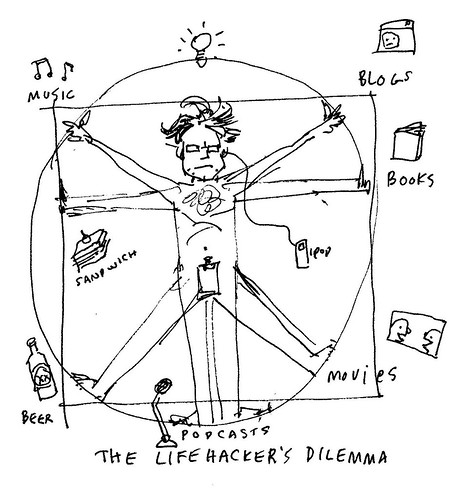
The lifehacker's dilemma


Vitruvian Mann, originally uploaded by dgray_xplane.

Too many distractions, too little time. Co-developed with Merlin Mann of 43 Folders.

Keep in touch! Sign up to get updates and occasional emails from me.

28 July 2006

The grand-daddy of business visualizations


Shadow, originally uploaded by dgray_xplane.

Yes, the Toronto Globe and Mail has proclaimed me the grand-pappy of business visualizations.

Keep in touch! Sign up to get updates and occasional emails from me.
12 July 2006

What is twttr and how do you pronounce it?

I just had dinner with Evan Williams and his lovely fiance Sara Morishige. Somewhere between the kalua pig and the bannana bread pudding, Evan gave me a hot scoop: his company, Odeo is about to launch a new service called twttr. It's pronounced "twitter" and you can find it at http://twttr.com (If you're less hip and more literal, like me, you can also find it at http://twitter.com).

The idea is that you can keep your friends informed of where you are and what you're doing by text-messaging them from your mobile phone. If you think about it it's a pretty cool idea: You can subscribe to text messages from your friends and they can "blog" their wheareabouts and doings. So, for example, if you're going to be in a certain city, or a certain coffee shop, or a certain club -- you can text message all your friends in one go, for example: "I'm going to the Starbucks at Market and Polk. Meet me if you want to play Scrabble."

People will get your text message immediately no matter where they are -- it's more immediate than a blog or email, and if they happen to be nearby, you haven't missed an opportunity to hook up.

Keep in touch! Sign up to get updates and occasional emails from me.

30 June 2006

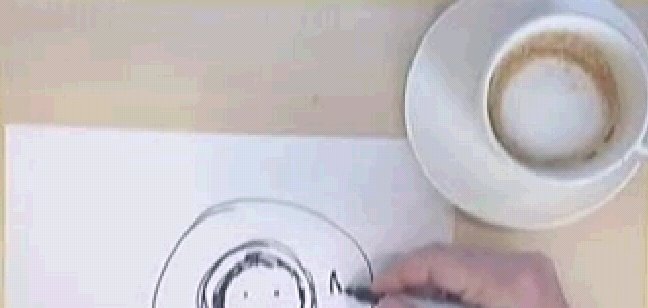
Take a coffee break with me


Yes, I know you're busy, but you can spare a couple of minutes, can't you? C'mon, let's go.

Keep in touch! Sign up to get updates and occasional emails from me.

11 June 2006

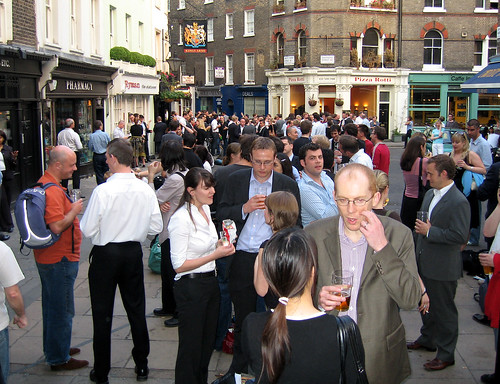
Shepherd market, Mayfair, London

If you're reading this and it's Sunday June 11th, then I am loose in London.

Keep in touch! Sign up to get updates and occasional emails from me.
01 June 2006

Location

Update on my itinerary: Just leaving Houston. Home in St. Louis over the weekend, then headed for Denver, then London. If you want to hook up in Denver or London please send me an email!

Keep in touch! Sign up to get updates and occasional emails from me.
28 May 2006

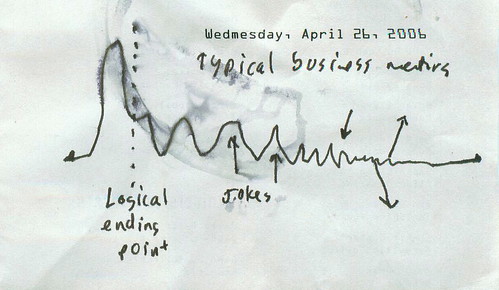
Graph of a typical business meeting

Cllick here to read more notes and commentary, and to add your own!

Keep in touch! Sign up to get updates and occasional emails from me.
25 May 2006

Social media


Social media, originally uploaded by dgray_xplane.

Why doesn't the typical meeting work for you anymore?

Why, when you see the laptop come out and the lights start to dim, do you feel a vague sense of dread?

Maybe it isn't so vague?

Maybe you've become used to a different way of interacting; a different kind of media. Social media.

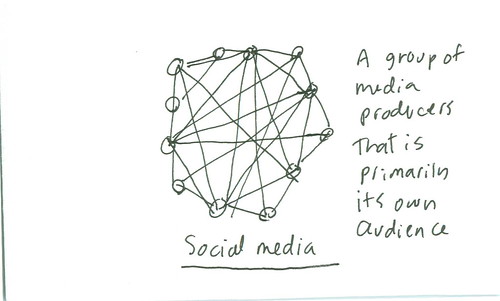
What is social media? I think of it as a group of media producers that is primarily it's own audience.

I was first introduced to this idea by Alex Vieux of Red Herring, who defined the Red Herring media ecosystem as a global social network of entrepreneurs, technologists, and financiers who were primarily interested in each others' activities and ideas.

A short while later I sat next to Ross Mayfield of Socialtext, who for three days running attempted to convince me of the power of wikis -- I am sad to say, without success. Those of you who know me are aware that I can be quite slow on the uptake sometimes.

Later I met Jerry Michalski, who is so passionate about social media that he named his company Sociate.

You wouldn't be reading this if you weren't already connecting to the world of social media. Which is why, I submit, that meetings of the traditional type don't work for you any more. You're no longer a couch potato, watching TV in the evening, being spoon-fed your media. And you don't want that role in your business meetings either.

You've become a part of the social media ecosystem. In addition to being a consumer of media, you're now also a producer. You've become accustomed to having a voice in the conversation. Social media is a clear phenomenon and it isn't going away.

So you can imagine my surprise when I searched the web for a simple, clear definition of social media and came up empty.

My definition is in the picture above.

What's your definition? Please leave a comment and share your thoughts.

Keep in touch! Sign up to get updates and occasional emails from me.
23 May 2006

Meshforum 2006


Meshforum 2006, originally uploaded by dgray_xplane.

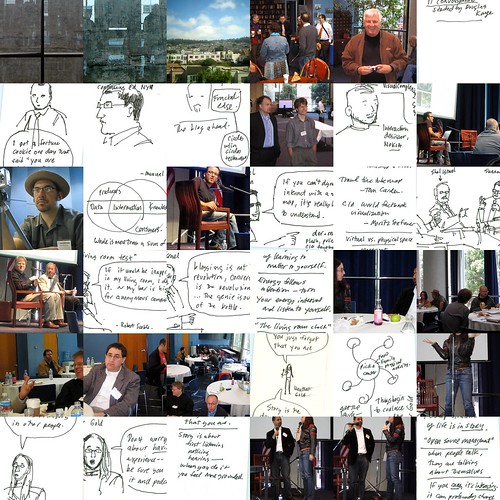
As you may know I recently attended Meshforum 2006 in San Francisco. It was a wonderful event -- I took a lot of photos, and copious notes on index cards.

A few people joined the event late and asked what they had missed. Instead of trying to explain it I was able to hand them a stack of index-card notes. The notes gave me a way to share personal impressions of the event without losing my focus on what was currently happening.

I have taken photographs of the events and put them alongside the index-card notes, in roughly chronological order. Looking at the photos and notes in sequence may give you a feeling for a personal experience of the event -- I hope you enjoy it. Take a look.

Keep in touch! Sign up to get updates and occasional emails from me.
22 May 2006

Visual thinking with Legos


2006FEB121501, originally uploaded by bootload.

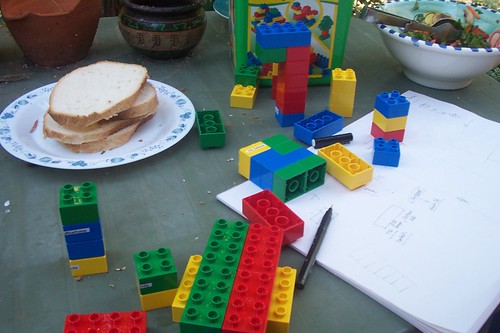
Peter Renshaw uses Lego building blocks as a visual thinking tool.

It all started when Peter and a friend (Russell) went to lunch with pens, paper, books, folders and a whole heap of Lego blocks. Each block represented a function or layer of code. They got a few odd stares, but ended up with a set of building blocks that they thought could solve the problem.

Lego blocks allowed Peter and Russel to clearly visualize what they were trying to do. Think of it as three-dimensional sketching for object-oriented programming.

Assemble a whole lot of modules that can be plugged together to accomplish something.

Peter and Russell were inspired by SAP, the global enterprise software company. Over time, SAP has compiled a tightly integrated grid of modules which can be plugged together in various ways to build solutions.

Here's Peter on how they do it:

"There's no special meaning to the choice of colour or size of blocks, aside from the fact that we join the blocks together to see, and, more importantly, think, how they can come together. Each block or module is uncoupled. That means it does one thing and one thing well.

This is the advantage of using blocks. Click them together to see what you need to acheive a particular task. Its not quite UML and we may miss something. But its cheap, and if used intelligently, does the job."

Click here to look at the annotated photo and read more thoughts from Peter.

Keep in touch! Sign up to get updates and occasional emails from me.
Robert Scoble's "living room test"

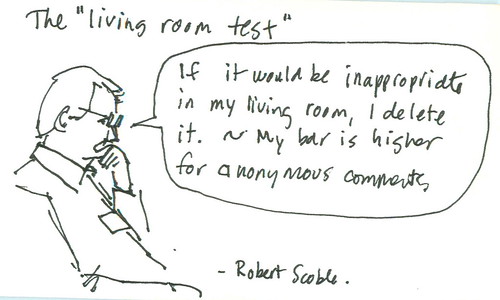
I asked Robert Scoble how he handles comments on his blog. His answer above. He calls it "the living room test."

Keep in touch! Sign up to get updates and occasional emails from me.
18 May 2006

I'm in Washington DC


I'm in Washington DC, originally uploaded by dgray_xplane.

I am in DC today (Friday) and Saturday. Send me an email if you would like to hook up Saturday at dgray [at] xplane [dot] com. Cheers!

Keep in touch! Sign up to get updates and occasional emails from me.

16 May 2006

The digital handmade


"Skepticism about the consumerist frenzy in the technology industries has led some practitioners to work with low-tech or outdated equipment, deliberately refusing the allure of commercial polish in favor of handmade aesthetics. Many of these self-styled creators deliberately turn to low-tech production platforms in order to make work that is accessible, inexpensive and often innovative in unexpected ways."

Take a look.

Keep in touch! Sign up to get updates and occasional emails from me.

15 May 2006

Pen and paper porn


Workspace, originally uploaded by jazzmasterson.

I love paper, but Josh DiMauro is a true paperhaulic. His Flickr photostream is the ultimate in GTD porn.

For those of you who don't know yet, GTD stands for Getting Things Done, a set of approaches and ideas by productivity guru David Allen and evangelized by Merlin Mann of 43 folders, John the Baptist of GTD and inventor of the hipster PDA.

Josh's blog, Paper bits offers a wonderful romp through his paper-loving world, where index cards, coin envelopes, binder clips take on a new life as productivity accelerators.

Josh isn't a luddite though, he embraces technology for the things that it's good for. But Josh and I agree: Always start on paper.

Related posts:
The best technology ever invented
The back-to-paper movement
Why techies are leading the back-to-paper movement

Keep in touch! Sign up to get updates and occasional emails from me.