24 June 2007

A blog is a way to change a company from the inside

... but not the way you think. A blog is a way of getting support and affirmation from the outside, for the things you are trying to do on the inside.

A blog is a way to keep your faith alive.

As always, please share your thoughts.

Keep in touch! Sign up to get updates and occasional emails from me.

22 June 2007

Did You Know 2.0

Would love to hear your thoughts on this.

Keep in touch! Sign up to get updates and occasional emails from me.

01 June 2007

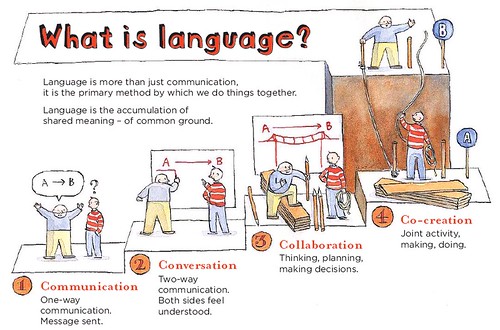
What is language?


What is language?, originally uploaded by dgray_xplane.

Keep in touch! Sign up to get updates and occasional emails from me.
31 May 2007

WikiMindMap


1. It's a mind map program
2. It's 100% online
3. It searches any term on Wikipedia and automatically creates a mindmap

Yes it's true and it's very cool. Check it out.

Keep in touch! Sign up to get updates and occasional emails from me.

15 May 2007

Visual thinking

Great presentation on visual thinking by Ryan Coleman.

Keep in touch! Sign up to get updates and occasional emails from me.

13 May 2007

What makes a place great?


Corner nook, originally uploaded by dgray_xplane.

"It's surprisingly simple.

Over the past 30 years Project for Public Spaces has evaluated more than 1,000 public spaces, and informally investigated tens of thousands more. From all this we have discovered that most great places--whether a grand downtown plaza or humble neighborhood park--share four key qualities:

1. It is accessible and well-connected to other important places in the area.
2. The space is comfortable and projects a good image.
3. People are drawn to participate in activities there.
4. It is a sociable place where people like to gather, visiting it again and again."

Read more.

Can we do this in our common (shared) office spaces? What makes for a great shared space?

Please share your thoughts.

Keep in touch! Sign up to get updates and occasional emails from me.

07 May 2007

Ice breaker


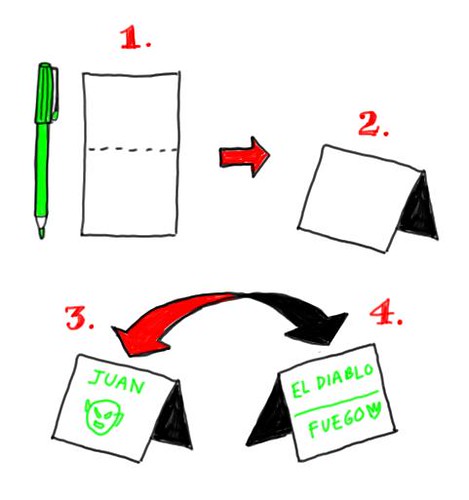
Ice breaker, originally uploaded by dgray_xplane.

Here's a simple but effective way to break the ice and introduce people at your next meeting or event. It's a good way to get people into a brainstorming/creative mood and sets the tone for a creative meeting.

1. Give everyone an index card and a colored marker (it's better if everyone has a different color).

2. Have each person fold the card in half to make a table tent.

3. On the front, have them write their name and draw their "supermask" (as in, if they were a superhero, what would be their mask?).

4. On the back, have each person write their "supername" and "superpower."

5. Go around the room and have each person describe their card to the group.

Variations:

1. If everyone more or less knows each other: After writing their name, have each person pass their card to the person on their left or right. The person receiving the card fills it out and passes it back. Then go around the room as before.

2. Instead of "supername" and "super power" you can try other things, like "wrestler mask, name and secret move."

3. Corporate version Have each person draw a self-portrait on the front of the card, and on the back write something others are unlikely to know about them.

We did this at a recent edition of visual thinking school and it really livened up the meeting. Here are the results.

Give it a try, and post your cards to the vizthink! pool.

Keep in touch! Sign up to get updates and occasional emails from me.
02 May 2007

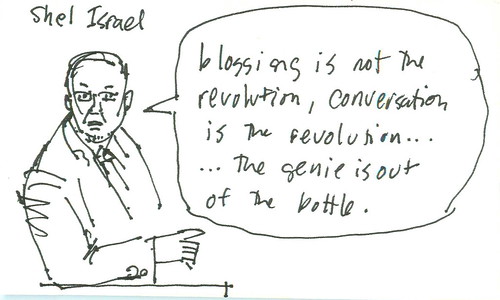
The most important technique of presenting

"Look your listener in the eye. Most inexperienced speakers lose the attention of their audience by looking up at the ceiling to collect their thoughts, looking at the floor, or darting their eyes around the room.

Whether you are addressing a small or large group, lock your gaze on one person, and keep it there for about five seconds - long enough to complete a thought. Then look at another person, take a breath, and continue with your next thought.

If you are talking to only one person, you'll want to break eye contact once in a while to avoid staring. But looking at one person per thought, and pausing slightly between each thought, is the most important technique of presenting."

-- From How to shine at presentations by Kevin Daley, founder of Communispond.

Keep in touch! Sign up to get updates and occasional emails from me.
23 April 2007

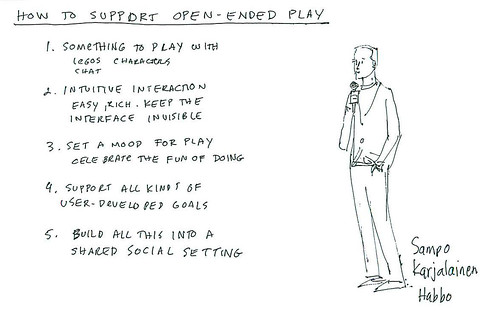
How to support play

Keep in touch! Sign up to get updates and occasional emails from me.
22 April 2007

Drawings are conversations


Help me write a story!, originally uploaded by dgray_xplane.

"A drawing is a conversation with yourself."
-- Vitor Higgs, infographer

Keep in touch! Sign up to get updates and occasional emails from me.

19 April 2007

Sketches of Morrocco

Beautiful sketches of Morrocco by Enrique Flores Here's another one.

Keep in touch! Sign up to get updates and occasional emails from me.

18 April 2007

Website on a dry-erase board?

Click the picture to read more.

Keep in touch! Sign up to get updates and occasional emails from me.

15 April 2007

Self-Governing Workshops and Offices

Conflict
No one enjoys his work if he is a cog in a machine.

Resolution

Encourage the formation of self-governing workshops and offices of 5 to 20 workers. Make each group autonomous- with respect to organisation, style, relation to other groups, hiring and firing, work schedule. Where the work is complicated and requires larger organisations, several of these work groups can federate and cooperate to produce complex artefacts and services.

From A Pattern Language by Christopher Alexander

Keep in touch! Sign up to get updates and occasional emails from me.

Tooth mapping

This graph is a visual record showing the health of a patient's gums.

The red dots indicate bleeders that appear as the dentist probes the gums for their health. The graph-like bars that over-lay the teeth are measures of the gaps between the teeth and the gum.

Keep in touch! Sign up to get updates and occasional emails from me.

Five secrets of the curious infographic

These are notes from a talk given at Malofiej 15 by Graphics Editor Marcello Valoncini.

1. Look forward.
Don't stop with the news, simply reporting what has occurred.
2. Reach out. Don't be shy; call people and ask for details.
3. Watch TV. Look to the television medium for ideas and particulars.
4. Compare elements. Even if they seem absurd at first, comparisons help people understand things in a larger context.
5. Use the internet. It can deliver strange, funny or useful elements to enhance your story.

Keep in touch! Sign up to get updates and occasional emails from me.