16 September 2005

Infect your environment

Do you let small issues build up inside? Do you simmer? Does it raise your stress levels?

If you want to change things, you need to believe that you can start small and still have big impact.

In this case, starting small means you begin to turn the tables by investing your positive energy, a little bit at a time.

From 43 Folders: "At work we usually wait until we've had enough of a particular situation and explode, leaving a lot of bad feeling and damage. If we can begin to infect our environment in a positive way on a daily basis, the changes will be lasting, less damaging and sustainable."

Keep in touch! Sign up to get updates and occasional emails from me.

Dealing with the poor performer

Open Loops: "You may have been a manager of a department for quite a while and, either by sheer enlightenment or a kick in the seat of the pants from someone higher up, you suddenly see problem performers that you have never seen before. In any case, you must now deal with the poor performer. "

Keep in touch! Sign up to get updates and occasional emails from me.

15 September 2005

Writing prompts for analytical types

Are you a spreadsheet kinda person? Need to be creative about your communications, but not sure how to go about it?

Check out Writing Fix: Left-Brained Writing Prompts...Long Live Logic and Structure!: "The writing activities housed on this page celebrate a left-brained approach to writing and challenge you to be more logical as you come up with ideas for writing topics"

Keep in touch! Sign up to get updates and occasional emails from me.

14 September 2005

Are you living in a prison of your own design?

Do you see problems in your workplace?

Do you feel like you know how to fix these problems, but nobody's interested in hearing about it? Do you feel that you're not listened to, that you have no impact, that you are powerless to effect any meaningful change?

It could be that you are working in one of those top-down, hierarchical or highly political companies where nobody wants to hear about problems, and independent thought is not a virtue. But there are fewer and fewer of these companies every day, because they are going out of business. The world is changing too fast, and no company can avoid change and survive.

So consider this: what if it's not your company that constrains you at all? What if it's you?

It might be time to look at your constructions. Try asking yourself these key questions:
1) Are you really powerless? How much of your powerlessness is based on assumptions? Nearly everything has been talked about before or tried before, right? What makes today any different? Why should you succeed when others have failed? This is an imprisoning thought process. Today is always different, and you can succeed where others have failed; it happens every day.
2) Are you sure you want change? Most of the time it's easier to talk about change than to do it. If you really want things to happen, you have to be willing to put significant effort into it. You may or may not be rewarded. To a true change agent, the change itself is the real reward.
3) Are you talking or doing? Most change agents don't ask permission, they just make things happen. And much of the time, their bosses appreciate it. When you see a problem, do you talk about it or do you fix it?
4) Are you willing to take a risk? It's true that people sometimes get fired for sticking their necks out. But it's equally true that people get promoted for the same reason. Do you want to stay where you are? Then do your job, keep your mouth shut, and live with the status quo. Do you want to go places? Stick your neck out. Put your job on the line for something you believe in. No risk, no reward.
5) Do you bring problems to the table, or solutions? It's one thing to identify a problem, and quite another to be able to solve it, especially with limited resources. If you want people to listen to you, bring achievable solutions to the table, and be ready to take the lead if asked.
6) Why not? This is one of my favorite questions, both as a manager and as a practitioner. In my opinion it is not asked nearly enough. Try asking it at your next meeting.

If you feel powerless, you are living in a prison. It could be that the prison is real. It could be that you have designed it yourself. Either way, it's important that you break out of prison, now.

Think of it this way: if everyone keeps their head down and their mouths shut, and nobody sticks their necks out, the whole company will probably go down in the end. So if you stand up for positive change you win either way:
- If you get fired, you leave a sinking company earlier rather than later.
- If you get promoted, both you and your company will be better off.

It's time to start planning your jailbreak.

Keep in touch! Sign up to get updates and occasional emails from me.

13 September 2005

Find that word that's on the tip of your tongue

Trying to think of a word?

Try the OneLook Reverse Dictionary: "OneLook's reverse dictionary lets you describe a concept and get back a list of words and phrases related to that concept. Your description can be a few words, a sentence, a question, or even just a single word. Just type it into the box and hit the 'Find words' button. (Keep it short to get the best results.) In most cases you'll get back a list of related terms with the best matches shown first. "

Keep in touch! Sign up to get updates and occasional emails from me.

12 September 2005

Find anything

Are you a master of the Boolean search?

No? Me neither. If you want an easy way to power-search Google, without an MST (Masters in Search Technology) check out the Google Ultimate Interface, from Fagan Finder.

Find anything or your money back.

Keep in touch! Sign up to get updates and occasional emails from me.

11 September 2005

From fog to focus

Are you caught in a fog?

Do you feel that, although you are working as hard as you can, you can't clearly see the road ahead?Despite your hard work, do you feel that you're making progress too slowly? Like running in sand? Or worse yet, is it both? Like you're caught in a fog and running in sand?

Changing your perspective might change your reality.

People often look at things in a linear way. That is, we tend to think of everything as having a beginning and an end. This task has started; this task is complete; these others are underway; that one is on hold.

But when you look at the world around you, most endings are also beginnings. The world of nature is a world of cycles, not linear events. Rain falls from the sky and eventually ends up in the clouds again. Day and night, phases of the moon, and the turning of the seasons are all cycles. As you look at similar cycles and begin to compare them, you can begin to see subtle differences you might not otherwise notice.

Noticing differences is the first step toward real progress.

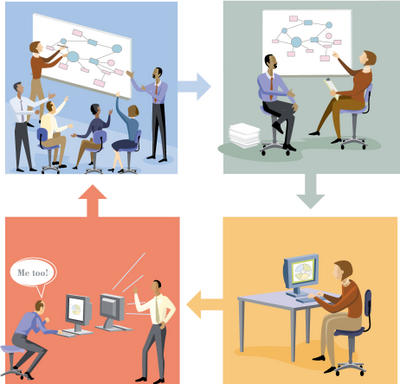
Whatever your situation, here are a few ideas that can help you establish a cycle, so you can begin to move toward productivity and meaningful results. You will make progress by completing cycles, noting differences, and initiating feedback loops.

Contextualize: Start by establishing a baseline and defining it somehow.What’s going on? Observe your situation objectively, as if you were on the outside looking in. Ask tough questions. As you gather information, you will see problems. Don’t point blame, but do your best to see the unvarnished truth. To avoid groupthink, reach out to peers and mentors, not only in your own industry but across as broad a base of industries, cultures and practices as you can find. A deep, contextual understanding of today will help you set your goals for tomorrow based on reality, instead of wishful thinking. Try to examine, document and report on the situation as if you were completely objective, like someone from another planet. If you don't have all the facts, don't let it hold you back -- guess. Don't worry, you'll always have more information on the next cycle.

Prioritize:What do you want, and by when? Approach the situation like an architect, not a mechanic. In other words, don't look at broken things and try to fix them! If you try to fix things, your best possible result will be a return to your former state. Think of it this way: if your goal is to get from here to there, fixing a broken motorcycle, at best, will get you a working motorcycle. You will never get to an airplane with that kind of thinking. To avoid being seduced by your assumptions, biases and blind spots, set clear, simple goals based on the what -- the end result you want to achieve -- as opposed to the how -- how you will do it. Most people can focus on three priorities at a time. What are your top three?

Visualize: How will you get there? Think about the resources that are available to you the environent you are in, and what's realistically achievable. Imagine what will need to be done in order to achieve your objectives. Imagine who is needed, and how it will be executed. Close your eyes and try to visualize it. Can you picture it? You might try drawing in on a whiteboard with stick figures. Where are the potential pitfalls? Can you anticipate these in advance, and mitigate their effects? How will you, or your people, know that they’re doing it right? How will you know when it's done?

Mobilize:Go. The sooner you get moving the sooner you will succeed. If you wait till your plan is complete -- till every contingency is covered -- you will never get anywhere. Progress, not perfection, is the goal. Enable decision-making as close to the action as you can. Build feedback into your execution mechanisms, so you can improve as you move. Some degree of failure is inevitable. Accelerate the failure to accelerate the learning.

Set the cycle in motion: Gather feedback to complete the cycle. Use it to enrich your thinking and improve your understanding of the situation. Feedback is the most important and most often neglected piece of the puzzle. When you first contextualize you are guessing. When you incorporate feedback and use it to re-contextualize you are improving. Feedback doesn't have to be numbers; it can be as simple as asking people questions about how you are doing.

Congratulations! By forging the critical link between mobilize and contextualize, you have established a baseline. Success does not come from perfect execution, but from a fast-moving cycle of continuous improvement. The faster you go, the more you learn. The more you learn the stronger you get.

Progress, not perfection!

Keep in touch! Sign up to get updates and occasional emails from me.
10 September 2005

Saturday night fights

Feeling contentious? Obstreperous? Ferocious? Vociferous? Welcome to another edition of Saturday night fights!

The main event this evening promises to be a battle royal: Microsoft vs. Google.
Dates are the dates of the blog entries, not necessarily events. What am I, your personal research assistant? And who cares about facts on Saturday night anyway? This is satire dammit!

Just trying to get you in the mood. Now let's rumble!

March 25, 1998: Microsoft patents ones and zeroes, creating a "lock" on the software industry.

May 3: Gates enters the fray, bringing "a ferocity that no one has seen since the Netscape war."

July 26: Microsoft and Google take to the skies in a battle for aerial supremacy.

August 2: A small Microsoft Delta Force enters Google territory.

August 23: Google launches a major counterattack into desktop territory.

August 25: Google Talk rips off the Microsoft butterfly. Zing! But Microsoft quickly responds by sending Scoble to Google to investigate.

August 31: Google announces plan to destroy all information it can't index. Ouch!

September 2: Ballmer throws a chair at @#$%! Google!

Both companies have become entangled in lawsuits and... hold on, the crowd seems to be leaving. Wait, the fight isn't over!

Well, if you must leave, try a random snack on your way out. If it doesn't suit your taste just hit the refresh button to try another.

Maybe you're leaving because you're goingt to a party tonight? Before you go, you might want to review Thirty - Eight Ways to Win an Argument, by Schopenhauer (just in case). My favorite is number 5: "Use your opponent's beliefs against him." Sometimes you need to defend yourself in casual conversation. This tactical training could be especially valuable if you happen to work for Microsoft or Google.

Keep in touch! Sign up to get updates and occasional emails from me.

09 September 2005

Want people to remember what you write?

"If you want people to learn and remember what you write, say it conversationally. This isn't just for short informal blog entries and articles, either. We're talking books. Assuming they're meant for learning, and not reference, books written in a conversational style are more likely to be retained and recalled than a book on the same topics written in a more formal tone. Most of us know this intuitively, but there are studies to prove it."

Lately, when it comes to clear communication, it seems to me that all roads lead to O'Reilly.

Keep in touch! Sign up to get updates and occasional emails from me.

Paint a picture in the minds of your listeners

Presentations: Public Speaking: "Painting pictures in the minds of your listeners is the key to effective presenting and persuasion. Yet many people dismiss this part of a presentation as just so much fluff. They may change their minds when they understand how the human brain processes information. "

Keep in touch! Sign up to get updates and occasional emails from me.

08 September 2005

Do you know how to say NO?

Sometimes the biggest key to increasing your productivity is to take some time and work on your "Stop doing" list.

Learning how to say no in a polite way is a good start.

Try it at least once sometime today.

Keep in touch! Sign up to get updates and occasional emails from me.

How effective is your workplace communication flow?

How effective is the communication flow in your workplace? Do people know what is expected of them? Do they know how they are doing and how they will be rewarded if they do it well?

I'm conducting a "lightning survey" to get a sense of how well companies out there are communicationg. I'd appreciate it if you would take a moment to answer 10 questions on how your workplace is doing.

Your response will be completely anonymous. As soon as I have 100 responses I will publish the results. Thanks in advance for your help!

[This survey is now closed. Check out the results!]

Keep in touch! Sign up to get updates and occasional emails from me.

07 September 2005

How the Moleskine Rocked My World

Speaking of paper, check out the following from Omar Shahine's WebLog : How the Moleskine Rocked My World:

"It's so weird how a small black book and a nice pen can change things."

"I feel that I've arbitrarily limited my own success because I never even allowed myself to consider paper as a tool for helping me. Kind of short sighted looking back."

"My Tablet PC and OneNote has an amazing writing experience, but my laptop is too big, heavy, and runs on batteries, making it non-ideal for note taking. Until there is a small slatelike device that can capture ink like the Tablet PC, I will probably never feel that it's suitable for the kinds of things my Mokeskines are."

Keep in touch! Sign up to get updates and occasional emails from me.

Paper comes to life

Curious AND intriguing. The following link comes courtesy of Haddock, by way of Plasticbag.org:

exbiblio - the concept: "Rumors of the death of paper have been with us for some time, and appear to have been exaggerated. If anything, the more time we spend at computer screens, the more we appreciate the qualities of paper; the flexibility, the low cost, the convenience, the reliability, and the ease of reading. Must we give up these advantages to gain the benefits of electronic documents?"

I do love paper.

Keep in touch! Sign up to get updates and occasional emails from me.

The dead elephant in the middle of the room

Many times in the corporate world, you will find yourself facing the "dead elephant in the middle of the room."

This is the issue that everyone is aware of, but somehow nobody mentions. It could be emotionally charged; it could feel too big to confront; it could be that nobody is comfortable bringing it up. If you are a manager, it might very well be that you are the only one who doesn't see it.

Nevertheless it is huge. It fills the room and it stinks to high heaven: it will be difficult, if not impossible, to get anything meaningful accomplished as long as it is there.

How do you know there's an elephant in the room? You might see the following symptoms:
- You catch people exchanging meaningful glances and you don't know why.
- People aren't responding to your thoughts or statements in the way you expected them to.
- You note awkward or uncomfortable silences and you don't know why.

How do you get the elephant out of the room so you can move on with business? Not by avoiding it, that's for sure. You need to shine a spotlight on it.

First you have to understand what it is. The best way to get this kind of information is by working on your listening and questioning skills. You may be able to do it in a meeting, but it may take more investigation. Try talking to people outside the office and having casual conversations. In a one-on-one situation, especially outside the work environment, people often feel more comfortable raising difficult or emotionally charged issues.

If they feel that you are listening and that you truly care, you probably won't have to ask the question at all; chances are that they want to bring it up. So don't probe. If you have to ask questions keep them general, like "how's work treating you these days?" If there's an elephant lying around and people feel comfortable with you, they will tell you about it.

If you are not a manager you can still bring it to your boss's attention in a similar way: get your manager off-site or in a comfortable environment, perhaps at lunch or over a cup of coffee, and try to bring up the subject as delicately as you can. Listening and questioning skills can be quite helpful here as well.

Once you are aware of the elephant, you'll need to raise the issue in a public forum. Here are a few thoughts about how to shine a spotlight on a dead elephant:
1) Broach the subject. No matter how uncomfortable it may be, you can't move ahead without bringing it up. At the beginning of a meeting, or towards the end, are usually the most opportune times. You may want to introduce it in a general way. Don't mention anyone by name, even though you may have discussed it with them. Just say, "a number of you have mentioned to me..." or "some of you might be wondering about..."
2) Call it like it is. You don't get any points for euphemisms or vague language. Describe the dead elephant in all its stinky ugliness.
3) Describe the emotions that surround the elephant. Don't be shy about sharing your personal emotions related to the issue. Seeing you talk about feelings will make others comfortable to do the same.
4) Ask people how they feel about it. Usually people are dying to discuss it and are happy to discuss it once the issue is raised. If people seem reticent, encourage them to talk. Whoever the first person to speak is, and whatever they say, listen carefully and show them that you understand. You don't have to agree, but letting the person fully air their views will serve to encourage others.
5) Schedule this kind of meeting later in the day, when people have a tendency to be more agreeable.
6) Follow up. This is a basic rule of management that is -- all too often -- forgotten or ignored. If you make a commitment or promise to address an issue, follow up and make sure it gets done. If you don't, you risk losing credibility with your team.

As always, please share your comments on the usefulness of these ideas.

Keep in touch! Sign up to get updates and occasional emails from me.