14 November 2005

Analyze your text

In a recent post called How easy is your writing to understand? I showed you how to use Microsoft Word to check the readability of your text.

Here's a tool you can use to quickly check the readability of any website or blog. You can also use it to do a deeper analysis of any text. Just enter the web address or paste in the text, and in addition to a readability index, you will get all kinds of interesting information, like

Number of different words used in the text
Average number of syllables per word
Sentence count
Average sentence length
10 most frequently used words
Most frequently used two-word expressions

Check it out: Textalyzer.

Thanks Hotlinks!

Keep in touch! Sign up to get updates and occasional emails from me.

13 November 2005

Visual thinking practice: Turning words into pictures

Here's a Pictionary-like exercise that's fun, easy and will help you hone your visual thinking skills.

You'll need a friend and a sketchbook, and you can do it nearly anywhere -- in an airport, a bar or over lunch. Here's how it works:

1. Each person makes a list of words and phrases. If you want you can pick a theme, like famous people, transporation, or dot-com companies.

2. Next, pick a word from your list and try to draw it. No letters or words allowed. It's your friend's job to guess the word. If your friend guesses the word you each get a point. If you give up, you lose a point.

3. Take turns and see how high a score you can get in an hour.

4. Next time you play, see if you can beat your record.

You can also play with three people: Every time someone correctly guesses what you're drawing, both you and they get a point.

Don't have any friends? No problem. You can also play this game online with anonymous strangers.

Keep in touch! Sign up to get updates and occasional emails from me.

12 November 2005

Visual thinking workshops

Starting this blog has sparked some interesting ideas and conversations about communication, learning and visual thinking.

I'm thinking about designing some XPLANE workshops that will focus on communication, learning and visual thinking. Do any of these sound interesting?

Hacking the Human OS: How to be more effective in life by understanding how people communicate, think and learn.

Visual thinking practice: Learn some fun and easy exercises that you can do to improve your visual communication skills. Bring paper or a sketchbook!

The seven C's of communication design: Seven principles that you can use to create more powerful, effective presentations.

The one-page proposal: How to boil your proposal down to a single-page storyboard

The power of paper: How to use flip charts, index cards and sticky-notes to become a better communicator.

If you have other ideas for workshops you'd like to see, let me know here.

I am conducting a quick survey -- six multiple-choice questions -- to get a better idea of what you want to see. Please take a minute to give me your thoughts.

Pictured: yes, that's a picture of visionary thinkers Biz Stone, Merlin Mann and Evan Williams in deep creative conversation in the Odeo conference room.

Keep in touch! Sign up to get updates and occasional emails from me.

Visual thinking practice: Your life as a book

People like stories about things they find interesting; things they are passionate about; and things they enjoy. If your life were a book, would you read it?

A treatment is the document used to sell an idea to film, tv and broadway producers. It's short -- anywhere from one to twenty pages long. It's also one of the best ways to organize a bunch of ideas into a story form.

If your life were a book, would you read it?

If your answer is no:
1. Write a treatment that describes your other life -- the book you would want to read.
2. Visualize it: storyboard the main scenes with stick-figure drawings.
3. Now sit back and look at the story you've outlined and ask yourself: is this the life you want or is it time to make a chnge?

If your answer is yes:
1. Maybe you should consider sharing your story with the rest of us. You can start by writing a short treatment with storyboards to organize your thoughts.
2. Take a quick skim through the writer's toolbox to get aquainted with some good writing techniques.
3. Now get started. If you want to work at it you can have your novel ready in 100 days.

Make no mistake: the story is the thing. And it starts with a blank sheet of paper. Will you start today?

Keep in touch! Sign up to get updates and occasional emails from me.

A quick-and-dirty reading strategy when time is short

A Quick and Dirty Reading Strategy When Time is Short: How To Find the Essential 20% (From Open Loops).

"To get the most out of a book, report, review, etc., in the least amount of time, try this strategy:

1. Read the title of the material.
2. Read the introduction.
3. Read the Table of Contents.
4. Flip through the material, scanning the chapter titles and sub-headings. Note the words that stand out as bold, different colors, underlined, or italicized.
5. Look at the illustrations and captions. Look at the charts and diagrams. Read the pull-quotes and sidebars.
6. Scan through the index looking for your particular business buzz words.
7. Now read the first chapter (or in a shorter work, the first paragraph).
8. Flip through the book and read the first sentence of each paragraph. The 80/20 rule says that only 20% of each paragraph is essential. Each paragraph should contain a topic sentence (the 20%). The rest of the paragraph is simply support material to defend the topic sentence, examples, illustrations, etc. (the 80%). The topic sentence is often the first sentence of the paragraph -- but not always.
9. Read the last chapter (or paragraph in a shorter work). If there is an executive summary, read it.
10. Read any other information on the cover or dust jacket."

If you're pressed for time and have a book you want to read, why not give it a shot?

Keep in touch! Sign up to get updates and occasional emails from me.

11 November 2005

Word abuse

The English language is a powerful and flexible communication tool. It's highly modular and can be bent, twisted and tweaked in numerous ways to convey complex meaning with great precision.

But as we all know, just because you are flexible doesn't mean you will be appreciated for it. In fact, the English language is so flexible that it is rarely respected and often abused. People will invent a new word on a whim, even when a perfectly good word with the same meaning already exists. Words can be arbitrarily truncated or extended and easily enter into common usage.

It's not that your writing needs to be formal; I prefer a conversational tone in writing because it's easier to understand. And I don't mind sentences that start with and, or sentences that end in prepositions, as much as some of the grammar nazis do.

But certain things grate on me like fingernails on a blackboard.

For example, here are some non-words that I hear all the time:
incent: A truncated form of incentive. Use encourage or you will incent a shudder up my spine.
remediate: This may be a word but it's lengthy and there are so many better words that are shorter and clearer: do you need it? You can remedy, repair or perhaps rectify this problem by using "fix" or "solve."
strategize: If you strategize a little more succinctly you might plan, or maybe even think!
messaging: It's your message or your messages -- or it's a mess.
marketspace: Use marketspace if you want to sound like a flake. Otherwise use market.

Are you a word-beater? This phenomenon is so profuse that any list of commonly abused words would be out of date as soon as it was written, and I am sorry to say that it is as common among professional communicators as it is in the world at large.

Especially if you are a professional communicator, educate yourself and be vigilant. And try not to use a long and confusing word when a short one will do.

What words do you hate to see abused? Post your comments.

Keep in touch! Sign up to get updates and occasional emails from me.

The mentat Wiki

This looks like a great resource for you Human OS hackers out there: The Mentat Wiki. Courtesy of 43 Folders.

Plus I love the name.

Keep in touch! Sign up to get updates and occasional emails from me.

10 November 2005

How to write a novel in 100 days or less

An inspiring essay, the gist of which is this:

If you want to write a novel you need to stop talking about it and start doing it.

But John Coyne says it in a much nicer way -- plus, he walks you through 100 days of novel-writing, one day at a time. You better believe it works: he's done it himself.

Keep in touch! Sign up to get updates and occasional emails from me.

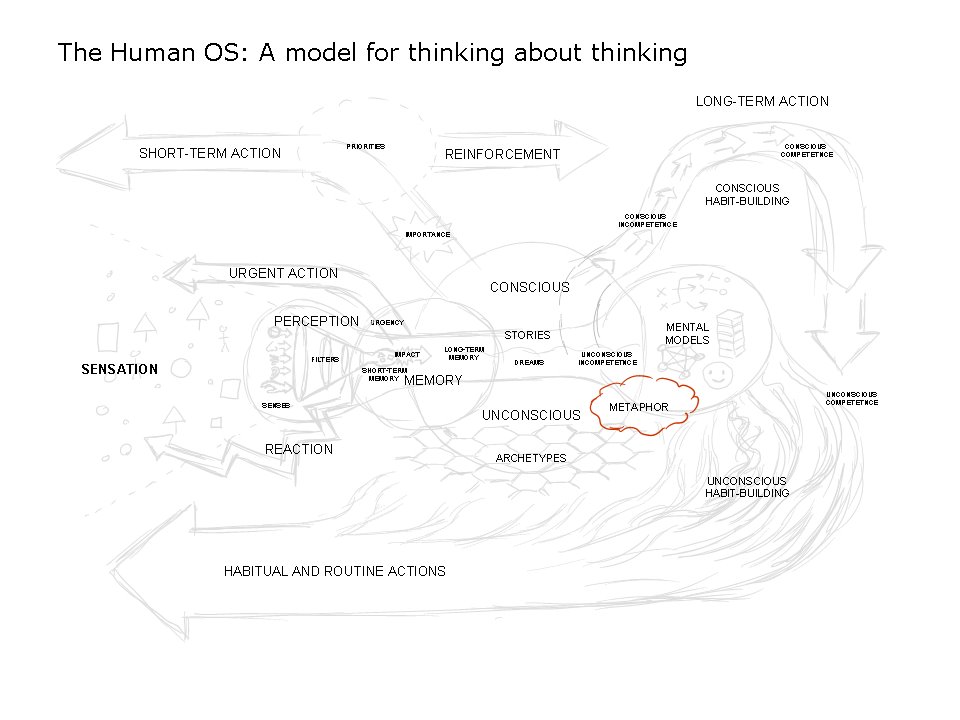
Hacking the Human OS > metaphor

Hacking the Human OS is a series of posts that investigates the mechanics of the human mind. Understanding your Operating System (OS) will help you think better, and help you get better, more consistent results from your interactions with other people.

As a tool for hackers, the metaphor offers both power and danger.

Power: It captivates, engages, and motivates people. Because it tends to trigger an emotional response it can galvanize people into action.

Danger: It's highly subjective and invites cynicism (as in "flavor of the month" and "Who Moved my Cheese?"). It's easy to poke holes in (as in, "That's very interesting Dave, but we're a technology company, not a spaceship").

So what is a metaphor exactly? It's a simple comparison between two seemingly unrelated objects. Hacking the Human OS uses the metaphor of a computer's operating system to represent the mechanisms of human mind.

Metaphors and analogies are like hyperlinks: they are a connection that molds a single thought out of two disparate ideas. You use them all the time without realizing it: for example, for most people up equals good and down equals bad. That's a metaphor.

Metaphors are frequently helpful when you want to explain something, especially when you want to clearly explain not just the facts but what they mean and why they are emotionally relevant. Frequently in business you will see things defined as a battle, or a race, or looming storms, even a tornado.

They are not merely tricks of language; according to two of the most recognized experts on the subject, they are concepts that govern our thought.

"The concepts that govern our thought are not just matters of the intellect. They also govern our everyday functioning, down to the most mundane details. Our concepts structure what we perceive, how we get around in the world, and how we relate to other people. Our conceptual system thus plays a central role in defining our everyday realities. If we are right in suggesting that our conceptual system is largely metaphorical, then the way we think, what we experience, and what we do every day is very much a matter of metaphor."

Here's more:

"To give some idea of what it could mean for a concept to be metaphorical and for such a concept to structure an everyday activity, let us start with the concept ARGUMENT and the conceptual metaphor ARGUMENT IS WAR. This metaphor is reflected in our everyday language by a wide variety of expressions:

ARGUMENT IS WAR
Your claims are indefensible.
He attacked every weak point in my argument.
His criticisms were right on target.
I demolished his argument.
I’ve never won an argument with him.
You disagree? Okay, shoot!
If you use that strategy, he’ll wipe you out.
He shot down all of my arguments."

Here are some other metaphor examples from the same book:

Time is money
Communication is a conduit
Happy is up, sad is down
Conscious is up, unconscious is down

For many people, a metaphor can be a ruling principle or deeply embedded worldview. For example, what is life? People have different metaphors; knowing a person's ruling metaphor can help you predict how they will act in certain situations:

Life is a game
Life is a battle
Life is a conversation
Life is an adventure

Serious conflict can arise when people's metaphors are not aligned. Part of the problem is that people don't know why they disagree so strongly. This is because even though metaphors have major influence on our thinking patterns and actions, for the most part they remain under the surface, unrecognized. The story of the blind men and the elephant is a perfect example of dueling metaphors.

In interface design we use a combination of office and building metaphors, which includes things like folders, pages, windows and home. Usually new ideas are introduced using metaphors. The metaphors improve adoption and limit thinking simultaneously, for example:

Metaphor: A photograph is like a painting.

Limitation: For years, photographs were all the same; static portraits and landscapes that used almost all the same conventions.

Here's another example: Are computer programmers engineers, architects or artists? Each metaphor has a different connotation and drives a different pattern of thinking. No matter which metaphor you choose, it will have a tendency to constrain your full potential.

This is especially helpful when you run into conflict, difficult conversations, or have trouble getting a point across.

As a hacker, you can use metaphor to reframe an issue so that people see it in a different light. To change their understanding of an issue, you can "reboot" their OS and build the new understanding on a new metaphor.

Think of a metaphor as X=Y, where X is the thing being represented and Y is the metaphor.

To reboot, ask yourself "what are the characteristics of X? What are its attributes?" Then ask "What else has similar characteristics or attributes?"

Next, see if you can replace Y by asking "What is an equal or better metaphor to describe the same thing?"

When people have a deeply embedded metaphor that governs their thinking and can't be changed, work with it. Put yourself mentally within their metaphor: Who are the players? What are the roles? Then put yourself in the metaphor and speak from the perspective that will help you make your point. For example, if the metaphor is football (American) you might find it advantageous to take on the role of coach, quarterback or fan to get your point across.

You can read more about this kind of reboot in Metaphor in Mediation, by Suzette Haden Elgin, Ph.D.

You might also try keeping track of peoples' overriding metaphors.

Take note when people have a "life-ruling" metaphor, and try to use the same metaphor when making your points. In your address book, jot down the metaphors you've noticed people use. When speaking to them, "follow the script" of their active metaphor.

Personally I have several life metaphors:

Life is a game
Life is a puzzle
Life is a quest

What are your overriding life metaphors? Please share your thoughts.

Keep in touch! Sign up to get updates and occasional emails from me.

09 November 2005

The human OS: metaphor

This post has been modified and can be found here.

Keep in touch! Sign up to get updates and occasional emails from me.

How to write more clearly, think more clearly, and learn complex material more easily

Highly recommended.

Keep in touch! Sign up to get updates and occasional emails from me.
Slow Leadership

Slow Leadership is a blog focused on helping leaders slow down and reflect so they can act intelligently.

Slowing down can help you focus on building the right relationships and the right momentum, so you get where you want to go, while retaining enough bandwidth to enjoy the journey.

And the journey is really the point anyway, right?

A lot of us could benefit by slowing down: I believe it was backpacker and author Harvey Manning who said "Make your world larger -- by going slower.

Keep in touch! Sign up to get updates and occasional emails from me.

08 November 2005

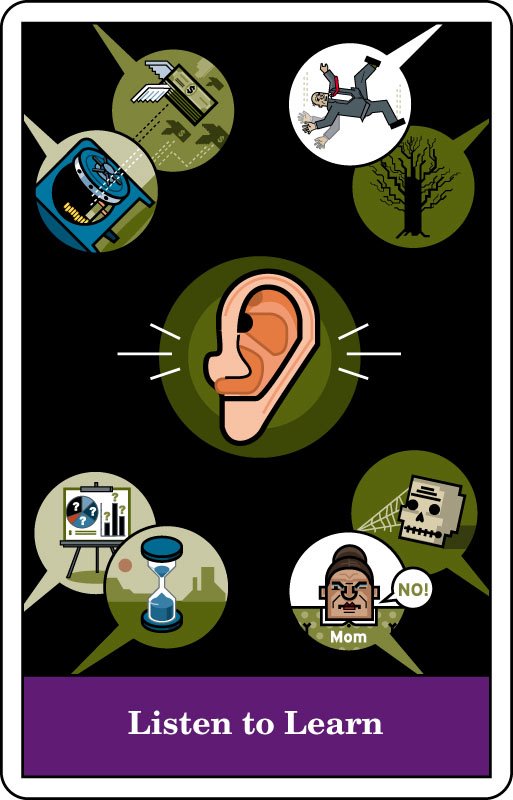
How to listen

Great communicators are great listeners. They pay attention and ask questions until they gain a deep and textured understanding of whatever situations they find themselves in.

An intellectual understanding is not enough: great communicators listen till they feel it. They empathize.

If you want to be a better communicator learn to listen, and more importantly, listen to learn.
As you talk to people, make it a habit to continuously check to confirm that you are understanding them correctly. The more questions you ask, the less tempted you will be to preach or prescribe solutions. How would you feel if your doctor prescribed medication before asking you about your symptoms? The more people talk to you, the more they will feel understood, and the more they will like you.

Here are the ten commandments of good listening:

1. Empty your mind. Try to begin with a blank slate. This will help you stay open to things you don't expect -- one of the most powerful things listening can do is open your mind to new ideas or reveal things that were formerly hidden.

2. Understand the context. Try to figure out what the person is trying to communicate and why. This will help you act in a manner that's appropriate to the context, and ask the right questions.
- Are they just venting or do they want to change something?
- What problem do they want to solve?
- What result do they want?
- Do they want you to do something? If so, what?

3. Don't get distracted. Your mind will have a natural tendency to wander, because we can think faster than people can talk.

4. Use follow trails. A follow trail is a simple question that you can keep asking till you get to the root of something. Just continue to ask the question till you get to the source. You'll be surprised how powerful this one is. Here are some examples of follow trail questions:
- And?/and?
- Why?/why?
- How?/how?

5. Use body language. Your physical behavior signals how well you're communicating. The most important signal is your eyes. Make steady eye contact and focus on the person's face. Nodding and leaning forward also signal attention.

6. Ask questions. Like a good detective, the art is in asking the right questions, and asking them well.

7. Take notes. It demonstrates that what the person is saying is important enough for you to write it down. Occasionally, verbally summarize your notes out loud, to show the other person you are hearing and understanding them.

8. Confirm your understanding. As you listen, think about how the person's thoughts would work in practice. play out scenarios in your mind and ask the person to confirm your understanding. For example, ask the person:
- "So if I were to apply this, I would..."
- "So what you are saying is..."

9. Let the person finish before you speak. We listen and process information faster than people can talk -- this can result in reacting or answering before someone is finished speaking -- your mind is racing ahead. Not to mention it's rude. Don't interrupt.

10. Don't judge too quickly. Suppress your own reactions -- remember to maintain that blank slate in your mind. Reserve judgment till the end of the conversation (or even later). If you keep an open mind you will reap the full benefit of the conversation and if you don't, you are limiting its potential.

Next time you communicate -- whether it's with an individual or with agroup -- diagnose before you prescribe. The results will amaze you.

Keep in touch! Sign up to get updates and occasional emails from me.

07 November 2005

The blue ball machine

Words cannot describe this.

If you're a Windows user and you want to take it with you, you can right-click on it and set it up as an active desktop.

Thanks Richard!

Keep in touch! Sign up to get updates and occasional emails from me.

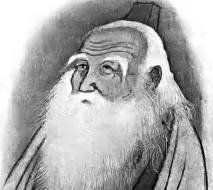
Lao Tsu's Tao Te Ching online

Lao Tsu is sometimes known as the father of Taoism; it is likely that he was a contemporary of Confucius.

"Written in China centuries before Christ, the Tao Te Ching offers incredible insight into the human condition. Originally the work of Lao Tsu, this text has been translated more frequently than any other work except the Bible. "

His words have been preserved for thousands of years, and for good reason. They are light and dense at the same time, and reward carefule reading and thought.

An example from Chapter 36:

That which shrinks must first expand.

That which fails must first be strong.

That which is cast down must first be raised.

Before receiving there must be giving.

This is called perception of the nature of things.

Soft and weak overcome hard and strong.

Fish cannot leave deep waters, and a country's weapons should not be displayed.

Read more, and search the full text, at Lao Tsu's Tao Te Ching Online.

If you like this you may also like Sun Tzu.

Keep in touch! Sign up to get updates and occasional emails from me.