29 April 2006

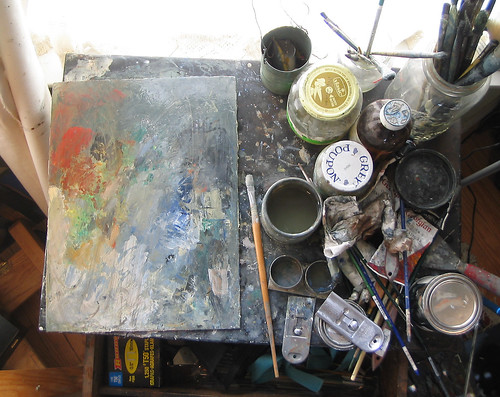
Still life


Still life, originally uploaded by dgray_xplane.

Oil on canvas, 12 x 16 in (30.5 x 40.6 cm). Collection of the artist.

If you want to get an email when my paintings go up for sale on eBay, please send me your email address at dgray [at] xplane.com or send me a flickrmail.

See the process.

Keep in touch! Sign up to get updates and occasional emails from me.

28 April 2006

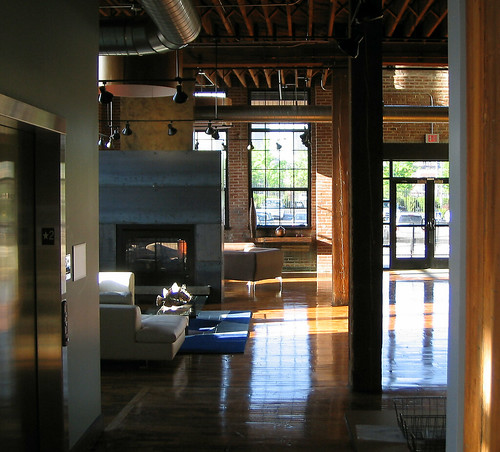
Transition from the street


Transition from the street, originally uploaded by dgray_xplane.

The experience of entering a building influences the way you feel inside the building. If the transition is too abrupt there is no feeling of arrival, and the inside of the building fails to be a sanctum.

While people are on the street, they adopt a style of "street behavior." When they come into a house they naturally want to get rid of this street behavior and settle down completely into the more intimate spirit appropriate to a house. But it seems likely that they cannot do this unless there is a transition from one to the other which helps them to lose the street behavior. The transition must, in effect, destroy the momentum of the closedness, tension and "distance" which are appropriate to street behavior, before people can relax completely.

Evidence comes from the report by Robert Weiss and Serge Bouterline, Fairs, Exhibits, Pavilions, and their Audiences,Cambridge, Mass., 1962. The authors noticed that many exhibits failed to "hold" people; people drifted in and then drifted out again within a very short time. However, in one exhibit people had to cross a huge, deep-pile, bright orange carpet on the way in. In this case, though the exhibit was no better than other exhibits, people stayed. The authors concluded that people were, in general, under the influence of their own "street and crowd behavior," and that while under this influence could not relax enough to make contact with the exhibits. But the bright carpet presented them with such a strong contrast as they walked in, that it broke the effect of their outside behavior, in effect "wiped them clean," with the result that they could then get absorbed in the exhibit.

-- From Enumerable.com

This image is from the lobby of XPLANE's new St. Louis office.

Keep in touch! Sign up to get updates and occasional emails from me.

27 April 2006

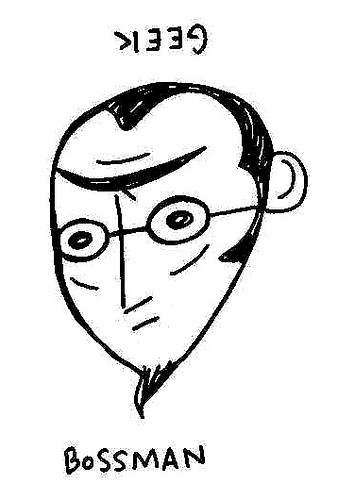
Bossman/geek


Bossman/geek, originally uploaded by dgray_xplane.

Bossman/geek drawing by XPLANE Creative Director Scott Matthews.

Keep in touch! Sign up to get updates and occasional emails from me.

26 April 2006

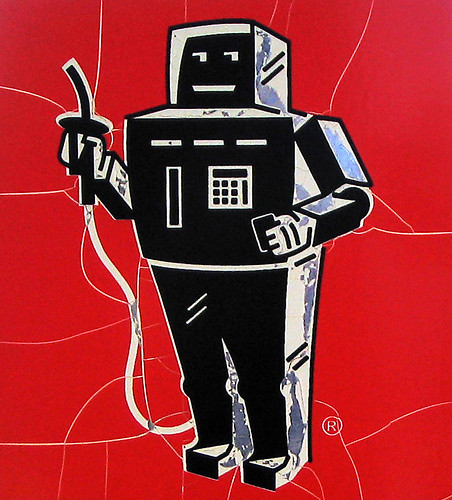
Fuelman


Fuelman, originally uploaded by dgray_xplane.

When there's no real person to embody an abstract service, marketers sometimes create fictional people to personify brand attributes.

The Maytag repair man, General Motors' Mr. Goodwrench, the MicroWarehouse customer service rep, Dell's Uncle Dudley—these characters help us visualize service qualities (such as "reliable" and "responsive") that otherwise might not come across as credible. Of course, invented characters can also backfire: Microsoft's intrusive Office paperclip figure personifies much of what users find obnoxious about Microsoft itself.

Read more in Softletter.

Keep in touch! Sign up to get updates and occasional emails from me.

25 April 2006

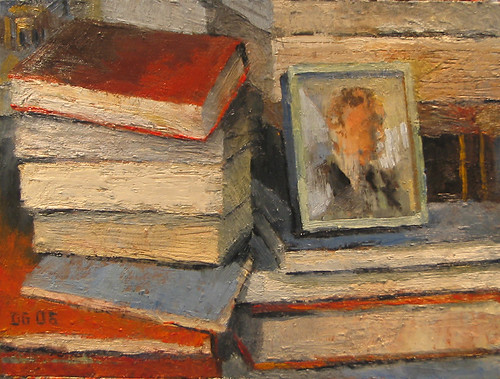
Still life with books


Still life with books, originally uploaded by dgray_xplane.

Oil on canvas, 12 x 16 in (30.5 x 40.6 cm). Collection of the artist.

If you want to get an email when my paintings go up for sale on eBay, please send me your email address at dgray [at] xplane.com or send me a flickrmail.

See the process.

Keep in touch! Sign up to get updates and occasional emails from me.

24 April 2006

After we've mapped everything, what's next?

When you've followed the thread of empirical science to it's logical ends -- when you've split the atom; when you've mapped the human genome, when you've discovered every land mass and every species and mapped the periodic table -- what's next?

We are getting closer and closer; we have deconstructed everything to the tiniest fragments, and yet it feels like we are no closer to the truth. Where is the next frontier?

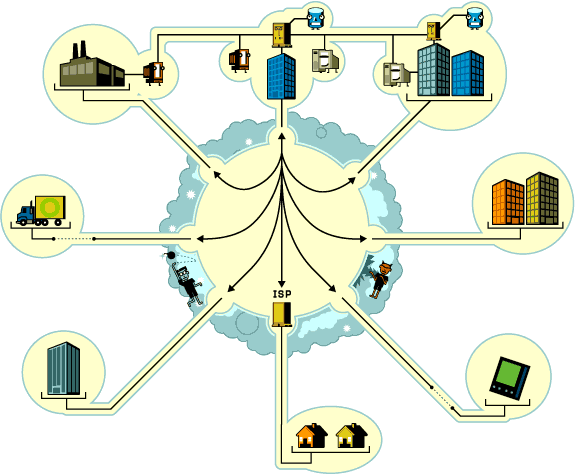
Networks.

The science of networks is the science of the future. It's the science of in-betweens, of connections, of dynamic ecosystems. It's inherent in the problems of turbulence, weather and heart attacks, of viruses, and nearly everything else that continues to elude us.

How many networks do you participate in? Are you on LinkedIn? Friendster? Flickr? Blogger?

ARE YOU ON THE WEB?

Recently I've been reading a book called Linked: How everything is connected to everything else and what it means, by Albert-Laszlo Barabasi.

Barabasi says that -- scientifically speaking --everything we thought we knew about networks is wrong.

How do we know? The internet is the first real man-made network that functions like an organic one. It's possible to study it because every aspect of it can be quantified and measured, and all its functions are known.

Exploration and analysis of the Internet has overturned many network theories of which, admittedly, I knew nothing. I won't go into them in detail here, but I highly recommend you buy the book. Barabasi's writing style is highly entertaining and readable, and the story fascinating.

The book ranges from six degrees of separation to Hollywood to cellular dynamics and why we haven't cured cancer yet. It talks about the long tail, the 80/20 rule, social networking and many other topics of interest to the Web 2.0 crowd.

One of the most interesting things to me is how wrong we were, and how little the subject had actually been explored until recently.

Which brings me to a fascinating opportunity called MeshForum, an upcoming three-day event in San Francisco (May 7th, 8th and 9th) that will bring together experts in all disciplines for an in-depth and wide-ranging conversation on networks: what they mean to us, what they can do for us, and their promise for the future.

And if that isn't enough, Robert Scoble will be there to talk about blogging and how he became the hub of everything. So please, get yourself over to the MeshForum website and take a look.

Keep in touch! Sign up to get updates and occasional emails from me.

You begin


You begin, originally uploaded by dgray_xplane.

You begin this way:
this is your hand,
this is your eye,
this is a fish, blue and flat
on the paper, almost
the shape of an eye
This is your mouth, this is an O
or a moon, whichever
you like. This is yellow.

Outside the window
is the rain, green
because it is summer, and beyond that
the trees and then the world,
which is round and has only
the colors of these nine crayons.

This is the world, which is fuller
and more difficult to learn than I have said.
You are right to smudge it that way
with the red and then
the orange: the world burns.

Once you have learned these words
you will learn that there are more
words than you can ever learn.
The word hand floats above your hand
like a small cloud over a lake.
The word hand anchors
your hand to this table
your hand is a warm stone
I hold between two words.

This is your hand, these are my hands, this is the world,
which is round but not flat and has more colors
than we can see.
It begins, it has an end,
this is what you will
come back to, this is your hand.

-- Margaret Atwood

Keep in touch! Sign up to get updates and occasional emails from me.

23 April 2006

See the world


Leaf, originally uploaded by dgray_xplane.

To see a World in a grain of sand,
And a Heaven in a wild flower,
Hold Infinity in the palm of your hand,
And Eternity in an hour

-- William Blake

Keep in touch! Sign up to get updates and occasional emails from me.

22 April 2006

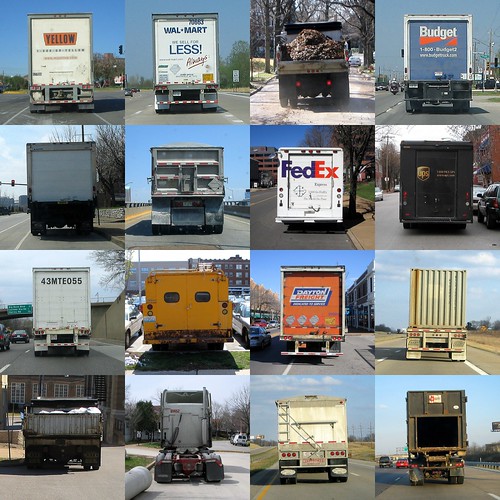
16 trucks


16 trucks, originally uploaded by dgray_xplane.

Keep in touch! Sign up to get updates and occasional emails from me.

How to perfect your presentation

"...one of the most effective sales presentation tools that I've ever been taught. Write your entire presentation out and then get some colored markers. For all the facts that you have written down, highlight them in red. Next, color all your humor in green. Lastly, color all your audience participation in blue.

Ok, now step back and look at your work of art. What, you don't see any green for humor? Where is the blue, for audience participation? Even if you are giving a sales presentation to manage $50 million dollars for a pension fund, you will be amazed by the audiences receptivity if you make the presentation about them. Red is a nice color but make sure your presentation has some green and blue to involve your audience.

Read on in Sales Presentation Training

Keep in touch! Sign up to get updates and occasional emails from me.

Everybody likes chocolate

I met a couple of friends/business associates recently and they gave me chocolate. What a great feeling that gave me and what a great touch. Everybody loves chocolate.

Chocolate Dividends

Keep in touch! Sign up to get updates and occasional emails from me.

The Encyclopedia Brittanica is mad

"The Encyclopedia Brittanica has expressed its extreme displeasure with the Nature science journal over its comparison of Britannica to Wikipedia.

Wikipedia is just as good as Brittanica, so the story goes. At minimum, Nature had described Wikipedia content as 'no more unreliable' than that in the venerable Brittanica. Now it has been suggested in The Register by Brittanica that Nature's research leaves much to be desired:

'Almost everything about the journal's investigation, from the criteria for identifying inaccuracies to the discrepancy between the article text and its headline, was wrong and misleading,' says Britannica."

Read on.

Keep in touch! Sign up to get updates and occasional emails from me.

Take a look


Take a look at Droom Zaacht, a beautiful drawing tool by David Lu.

Keep in touch! Sign up to get updates and occasional emails from me.

21 March 2006

The asynchronous conversation

An experimental interview with Maish R. Nichani of elearningpost.

If you've been reading this blog for awhile you know that Charlie Rose is one of my favorite interviewers. One of the reasons is that every interview he does feels like a conversation.

Robert Scoble's new book on the blogosphere is called Naked Conversations for a reason -- Scoble is not the only one who has noted that the world of blogging is a world of conversation. You may have noticed that recently I have been testing this model by asking you to tell me what you think.

So here's a big thank you for your overwhelmingly positive response!

I believe that conversations are important in the business world, and that they will only become more so over time; you can read more about that here.

So when it was time to do an interview I wanted to try something different. Maish R. Nichani has been blogging -- well, it seems like forever. His blog, elearningpost, is always full of fascinating and thought-provoking links. But Maish himself has always been a bit of a mystery. So I asked Maish if he would be up for a little "experiment in conversation." Luckily he said yes!

The asynchronous conversation
Most conversations are synchronous; that is, they happen in real time, either in person or by phone. Some conversations are asynchronous: email for instance. If I write you an email you can respond when it is convenient for you. The conversation in the blogosphere is mostly asynchronous. One of the benefits of an asynchronous conversation is that it's easier for people all over the world to join.

The idea behind this "experiment" is to do an asynchronous interview with Maish, and open the conversation up to you, the Communication Nation community.

I will kick off the conversation with a couple of questions for Maish, and he has agreed to watch the comments section, where I hope that a rich conversation will develop. Of course, that part is up to you.

Here goes...

Dave:
Maish, could you briefly introduce yourself and your work to Communication Nation readers?

Maish:
I’m the editor of the blog, elearningpost, http://www.elearningpost.com/. To serve my passion (and for survival) I run a small design studio (http://www.pebbleroad.com/) focusing on intranets, websites and e-learning. As far as work is concerned, I pursue a design-thinking mindset; and as far as life is concerned, I like to think of myself as a passionate learner. I use elearningpost to explore the vastness of the design-learning intersect. I never intended to do this of course; it just so happened that I stumbled across something that I like. I have the blogosphere to thank for that.

Dave:
What do you think people are missing? What (if any) topics do you think people should be thinking and talking more about?

Maish:
I think it’s good if people are missing things! George Clooney spoke about the same in his Oscar acceptance speech for best supporting actor where he professed that he was proud to be “out of touch” as being out of touch helped shine the light away from the stereotypical storylines.

And therein lies the crux of the matter for the rest of us.

It’s one thing to be out of touch, it’s totally another to do something about it. In this day and age, success, I think, comes to those who are comfortable being uncomfortable or those who deliberately practice being uncomfortable. But many of us shy way from being out of touch.
A few days ago I had a chat with a friend who runs creativity courses here and he signaled out the education system as the reason for this passive shyness. Right from the start we are told to draw on the lines and color inside the boxes and this conformity mindset has molded us into being passive receivers. But thanks to the Internet, there is hope.

The very nature of the internet – always hackable and always in beta – is helping to get the new philosophy across. Web 2.0 is an indication of this movement. If you think about it, Web 2.0 is actually making things messier. All this talk about platforms and mashups and APIs can make one dizzy, but yet, we seem to be coping well.

So, to answer your question on what we should be talking about, I think it would help if we could spend more energy on
1) learning from experience and
2) learning how to represent.

One lets us cope with the constant change, while the other lets us make sense of the constant change. James McGee posted an article on learning, mindfulness and reflection (http://www.mcgeesmusings.net/2006/02/27.html#a4734) that explains the first point. The second point is to do with what you’ve been doing with visual explanations – representing ideas to aid understanding. Representations, I think, are the driving force behind Web 2.0 and behind the Whole New Mind.

Dave:
Can you name some recent things you have seen or heard that you think are especially exciting?

Maish:
Web 2.0 apps are interesting. So is the prospect of reading Beautiful Evidence and Don Norman’s new book. I also like the current interest in experience design and narrative work. Also I can’t wait to play with the rumored calendaring app from Google. As you would have guessed, all links are from my blog!

Dave:
What role do you see for face-to-face conversations in an increasingly global and technologically connected world?

Maish:
When it comes to creating new knowledge – brainstorming, prototyping, sensemaking, etc., or when deciding on important things, having face-to-face interactions is crucial. Technology is useful when you’re dealing with the day-to-day working knowledge.

In short, face-to-face conversations are absolutely essential when the risks are higher or when you are dealing with complexity. They key is finding out what constitutes as being high risk or as being complex.

For example, in a well-documented story, around 2000 TBWA Chiat/Day tried a bold experiment with virtual offices. They gave their staff portables and mobiles and asked them to work from where ever they wished. The thinking was that advertising was a well-structured discipline and all one had to do was to follow the process. They learnt the hard way that this was not true when their staff walked out on them and demanded their space back.

Another well-documented story is that of the Challenger launch decision. Here an important decision on the O-rings was made over the phone. The situation was both complex and high risk and yet there was no face-to-face meeting.

So, if its complex and/or high risk, just meet up. For everything else, look for the best mix. Now, I could be simplifying things here, but it’s a good start.

Dave [to you]:
Now the experiment in asynchronous conversation begins. What questions do you have for Maish? What ideas did his thoughts trigger? Do you have a relevant story to tell? Please put your questions and thoughts in the comments section and join the conversation!

[Update: Based on what I am seeing so far, the asynchronous interview has the following attributes:

1. It moves slowly -- one or two questions a day seem to be the norm.
2. The conversation is rich and dense, like chocolate cake. And like chocolate cake it takes some time to digest. Read it slowly and thoughtfully.

Since this is my first asynchronous interview it's hard to say if this is a general rule. However the patterns are interesting and unique enough that I intend to do some more of these.

Keep checking back on this post -- rather than post new entries I am focusing my attention on this interview; I want to nurture it and see what dynamics develop. Until the interview loses momentum I'll be posting my thoughts in the thread.]

Keep in touch! Sign up to get updates and occasional emails from me.
17 March 2006

Dave Winer on the unconference

In case you haven't heard of him, Dave Winer is a pioneer in the blogging world; in his own words,

"I've been blogging since there is such a thing."

In a recent post Dave has some interesting thoughts about "unconferences:"

"The idea for an unconference came while sitting in the audience of a panel discussion at a conference, waiting for someone to say something intelligent, or not self-serving, or not mind-numbingly boring. The idea came while listening to someone drone endlessly through PowerPoint slides, nodding off, or (in later years) checking email, or posting something to my blog, wondering if it had to be so mind-numbingly boring.

A fundamental law?
This observation may turn out to be the Fundamental Law of Conventional Conferences.

The sum of the expertise of the people in the audience is greater than the sum of expertise of the people on stage.

It's probably much worse than that. My guess is that if you swapped the people on stage with an equal number chosen at random from the audience, the new panelists would effectively be smarter, because they didn't have the time to get nervous, to prepare PowerPoint slides, to make lists of things they must remember to say, or have overly grandiose ideas about how much recognition they are getting. In other words, putting someone on stage and telling them they're boss probably makes them dumber. In any case it surely makes them more boring.

Turning things around
So then, how do you turn things around so that we can harness the expertise we just discovered and get a discussion moving efficiently and spontaneously without forcing the interesting conversations into the hallway. I wanted to see if there was a way to get the hallway ideas to come back into the meeting room. It turns out there was.

First, you take the people who used to be the audience and give them a promotion. They're now participants. Their job is to participate, not just to listen and at the end to ask questions. Then you ask everyone whwho was on stage to take a seat in what used to be the audience. Okay, now you have a room full of people, what exactly are they supposed to do? Choose a reporter, someone who knows something about the topic of discussion (yes, there is a topic, it’s not free-form) and knows how to ask questions and knit a story together.

Read more in Dave's Wordpress Blog -- Blog Archive -- What is an unconference?

Photo by Jay Cross -- thanks Jay!

Keep in touch! Sign up to get updates and occasional emails from me.