07 November 2005

Hacking the Human OS: The map

Hacking the Human OS is a series of posts that investigates the mechanics of the human mind. Understanding your Operating System (OS) will help you think better, and help you get better, more consistent results from your interactions with other people.

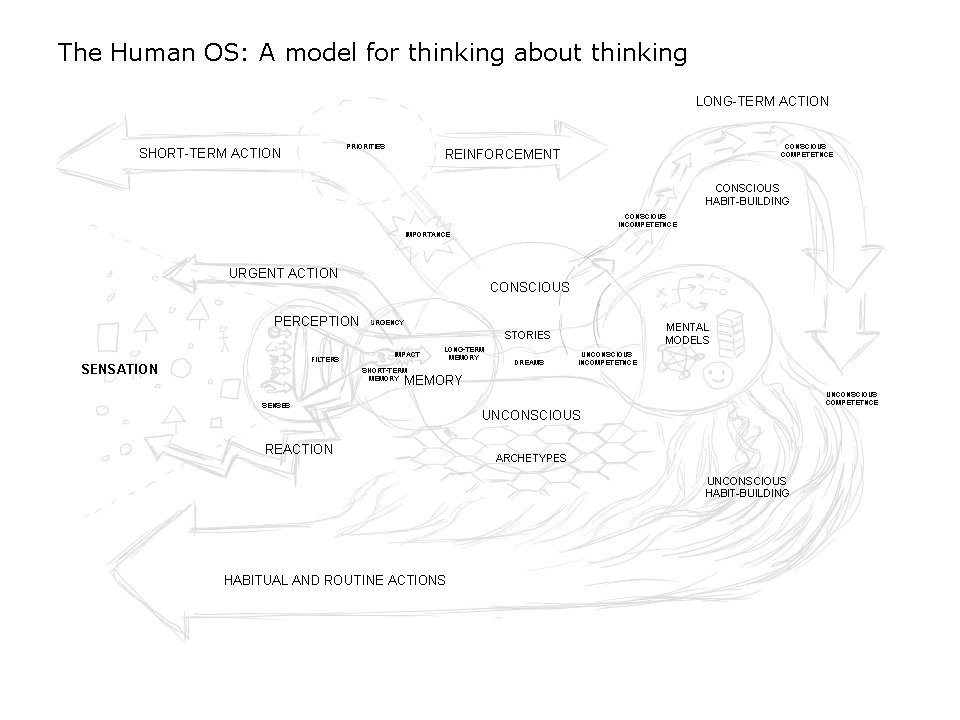
Here's a visual map that will serve to open the floor for discussion on the Human OS. At a very high level, the map visualizes my current understanding of how the Human OS functions as a system:

The primary inputs are sensations from the outside world.

The primary outputs are the actions that you take to create results in that outside world.

The primary feedback loop occurs when the impact that you have on the outside world drives more sensory inputs, which result in your understanding of how the world works and how you can be successful in it. One of the things we'll be talking about is the difference between positive and negative feedback loops, and what you can do to encourage positive loops in yourself and others.

Between sensation and action are the guts of the system, where you translate sensations into things like memories, mental models, habits, routine behaviors and priorities.

At the moment the map may not be self-explanatory. If it doesn't make sense yet, don't worry: in the coming week's I'll be posting more on the subject.

If you can make sense of it please share your thoughts; I consider it a work in progress and want to incorporate your thoughts and ideas. With your help, I will solodify the model as we move forward. The goal is to develop a functional model that people can use to effect change.

So what do you think?

Keep in touch! Sign up to get updates and occasional emails from me.

06 November 2005

How to implement a strategy

Knowledge management expert James Robertson offers 10 principles of effective information management.

Robertson's paper is specifically about knowledge management implementations, but I think the principles apply equally well to the implementation of any strategy. Here is a summary of Robertson's 10 principles:

1. Recognise (and manage) complexity: There is usually no one single solution to any problem. Rather than trying to "boil down" to a single approach, focus on articulating a clear direction that can help people see how different components weave into a larger approach.

2. Focus on adoption: Whatever it is you're implementing, if people aren't asking for it and they don't start using it, you're probably forcing it on them (and you'll probably fail).

3. Deliver tangible and visible benefits: Determine how you will measure success, be sure it makes sense, and measure it.

4. Prioritize according to business needs: Look for quick wins. Short-term, tangible benefits help drive adoption early, when people are skeptical and you need support most.

5. Take a journey of a thousand steps: Change is a marathon, not a sprint. A series of small steps, when aligned with a common and well-articulated vision, will increase your chances for success, and help reduce your risk of failure.

6. Provide strong leadership: If you're a leader, focus your efforts on communicating the vision, and making sure people understand the importance and urgency of the initiative.

7. Mitigate risks: Identify risks up front and plan how to address them. Expect that it will cost more than you think -- it will! One way to reduce risk is to tighten up the budget.

8. Communicate extensively: Establish a clear, simple message at the beginning of the project, and create a plan to communicate extensively throughout the implementation. If people aren't hearing about it they'll assume it isn't important. [Note: This is where XPLANE can help you create a change communication plan]

9. Aim to deliver a seamless user experience: Keep it simple, be clear and consistent.

10. Choose the first project very carefully: Think of your first project -- and plan it -- as a catalyst for change. Start by giving people something that helps them do their jobs better.

Read more in 10 principles of effective information management.

Keep in touch! Sign up to get updates and occasional emails from me.

05 November 2005

Saturday night fights

It's Saturday night -- time to pick up your Saturday Night Special and shoot some cute little stick figures (but only in self-defense, okay?).

Don't forget to reload!

Keep in touch! Sign up to get updates and occasional emails from me.
Cool tool: write-on poly sheets

Cool Tool: Write-on Poly Sheets:

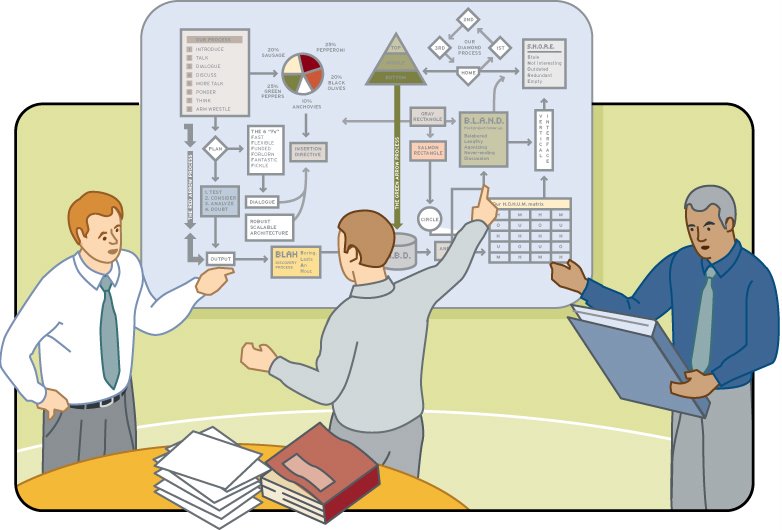
"Polysheet instant whiteboards are thick, static-laden sheets of plastic, like ultra-heavy garbage bags. Just unroll one, slap it on the wall, and instant whiteboard! Best of all, in the corporate world, at the end of the meeting, you can roll them up, take them back to your desk, and process them. After capturing the contents in your computer, wipe them off for next time!"

Buy some.

Thanks Kevin!

Keep in touch! Sign up to get updates and occasional emails from me.

An online crash course in typography

Keep in touch! Sign up to get updates and occasional emails from me.

What's your penguin score?

Michael Katz of Blue Penguin Development offers something he calls the Penguin Score. Although Michael is a specialist in email newsletters, it's a great way to score yourself on any communication.

Position: Did you take a position or try to please everyone?
Easy: Was it easy to understand? Did you use simple language or try to impress with jargon or tech-speak?
Narrow: Did you narrow it down to a few simple ideas?
Genuine: Is it genuine, sincere. Is it you?
Useful: Is it practical and can people apply it in their lives?
Infectious: Is it viral? Will it spark conversations?
uNexpected: Did you wake people up?

Here's how to score yourself:
For each attribute listed, assign a grade of 0,1 or 2 (2 being the best). Add up your total score and take the appropriate action:

11 - 14: Go with it!
8 - 10: Keep working.
5 - 7: Start over.
0 - 4: Have you considered a career in politics?

You can order printed Penguin scorecards for yourself or colleagues at penguinscore.com.

[Thanks to Adam Ciesielski for the penguin photo]

Keep in touch! Sign up to get updates and occasional emails from me.

04 November 2005

The search for happiness

It's
just
one
click
away.

Keep in touch! Sign up to get updates and occasional emails from me.

Are you sick of hearing about it?

It's time for a Friday rant.

I for one am sick of hearing about branding. Especially in the communications business, it seems like you can't walk around a corner without hearing somebody talking about it.

Branding, branding, branding.

Every time I hear the word I think of red-hot irons and burnt flesh. The very notion that you can slap a brand on nearly anything and that will change it for the better seems ludicrous. How's this for a notion: Make better products!

Take a minute to give me your own Friday rant before you go home for the weekend.

What are you sick of hearing about?

Keep in touch! Sign up to get updates and occasional emails from me.
A day in the life of the FAA

Check out the Flight Patterns.

Keep in touch! Sign up to get updates and occasional emails from me.

Why tagging is easier than categorization

"The rapid growth of tagging in the last year is a testament to how easy and enjoyable people find the tagging process. The question is how to explain it at the cognitive level." Curious?

Keep in touch! Sign up to get updates and occasional emails from me.

How to measure your communication effectiveness

Do you set understanding goals for your important communications? Most people don't.

If you don't set goals for your communications, you'll never know how effective you are. You won't be able to improve because you won't know how you're doing. How can you measure communication effectiveness?

At XPLANE we set "understanding goals" for any important document, presentation or interaction. There's a simple, easy way to do it, and it's one of the most powerful tools I have ever found in my quest for clarity: frame it as a question. Determine the question that your communication will answer for your audience.

There are three reasons for this:

1. To clarify why people should care.
If you don't offer anything new, why should anyone listen? Effective communication should result in someone acting or thinking in a different way than they did before.

Ask yourself: "What question do I want to answer for my audience?" Framing your goal as a question will help you define exactly what's new, and why people will care. If you can't define a question, maybe nobody's asking it -- and if nobody's asking the question, it's probably because nobody cares.

2. To be sure your content is complete.
Defining your goal as a question offers a second benefit: It's a check to ensure that your communication is on target. At any point in the design or delivery of your communication, you can ask yourself "Am I answering the question?" When it's time to edit, you can test the relative importance of any element by gauging the degree to which it contributes to answering the question.

If it's not contributing you can safely cut it completely. You'll be surprised how much information you deem extraneous or irrelevant when you start to use this approach.

3. To ensure you are understood.
You can also use questions as a metric, to test your communication's effectiveness. Ask someone to review your document, or practice your speech on them. Then ask them the question you intended to answer and see what they say. You can see how effective you have been by seeing how close they come.

This is also quite useful for management conversations. Before you have the conversation, define the question you want the other person to be able to answer. At the end of the conversation, ask the question.

You might be surprised at the answers you get. I have often been about to leave a conversation when I asked my question -- just as a check -- only to find that the other person was about to walk away with a completely different understanding than I had expected. You can save yourself a lot of wasted energy (and sometimes misery!) by double-checking that your communications are understood before moving on.

And you can't double-check unless you have a metric. Use questions.

Keep in touch! Sign up to get updates and occasional emails from me.
A new vision for electronic documents

Theodor Holm Nelson, the inventor of the terms hypertext and hypermedia, is on a mission to transform the world of electronic documents.

Here's the problem as he sees it:

"Instead of looking at deeper possibilities for electronic literature, the designers of today's electronic documents have imposed hierarchy and simulated paper. This has drastically limited us. We cannot annotate, we cannot publish side-by-side commentaries, we cannot legally quote at length, we cannot easily see the original contexts of quotes."

His term for the new world is "Transliterature," which he has copyrighted not for personal gain, but to contain what he calls "semantic creep."

Among his ideas are:

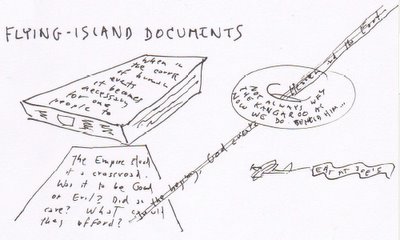
Parallel tracks that allow side-by-side comparisons. He sketches an interface where numerous comments are seen next to a document, like overlapping sticky-notes.

Color-coding to track multiple authors in collaborative documents, or where one author quotes another.

Eliminating the clipboard. The clipboard does not retain information about the author or origin of the information it contains. he advocates "pullacross editing" where you pull a text block from one document to another, retaining the link.

Deconstructing documents so that elements (Headlines, text, images, quotations) retain their connections but can also be viewed independently.

3D navigation that involves multi-diimensional documents flying and floating in 3D "gaming spaces."

Paradigm shift: Nelson proposes moving from WYSIWYG (What you see is what you get) interfaces to WYSIWYL (What you see is what you like) interfaces, where users can override the author's intentions to view documents as they see fit.

Read more in Transliterature, A Humanist Design:

"A document is not necessarily a simulation of paper. In the most general sense, a document is a package of ideas created by human minds and addressed to human minds, intended for the furtherance of those ideas and those minds. Human ideas manifest as text, connections, diagrams and more: thus how to store them and present them is a crucial issue for civilization.

The furtherance of the ideas, and the furtherance of the minds that present them and take them in, are the real objectives. And so what is important in documents is the expression, reception and re-use of ideas. Connections, annotations, and most especially re-use-- the traceable flow of content among documents and their versions-- must be our central objectives, not the simulation of paper."


I am strong proponent of paper, especially for visual and creative thinking. I remain convinced that great ideas nearly always start with napkin sketches. In fact, I can't help noting that Nelson himself is a prolific napkin-sketcher and appears to use pen and paper to think about virtual spaces and convey his ideas.

But electronic documents are not paper, nor do they need to be constrained by a metaphor that forces us to treat them as such. I see some potential difficulties in the approach he advocates. For example, color-coding has a built-in limitation, based on the number of colors most people can easily distinguish.

Nelson's vision is an expansive one and I look forward to seeing where it goes.

Keep in touch! Sign up to get updates and occasional emails from me.

03 November 2005

A page of utilities that help you do stuff

I want to: a page of utilities that help you do stuff you want to

Thanks Merlin!

Keep in touch! Sign up to get updates and occasional emails from me.

Do you suffer from analysis paralysis?

You are contemplating a new undertaking.

It could be a new product you're about to launch. It could be a change initiative at your company. It might be related to implementing a new technology solution or making a big purchase.

At any rate, you're not ready to take the plunge just yet. You haven't quite completed your plan. You need more information. More specifications, more analysis, another focus group. You haven't finished your analysis of the competitive landscape.

When will you be ready to start? It's hard to say. These things take time, and you wouldn't want to make a mistake.

It's time to face it: you may be suffering from analysis paralysis -- a slow, creeping disease that's contagious and tends to spread fast in many companies. It's deceptive as well; at first it causes only stagnation, but once it spreads to the entire company, it usually results in death.

People or companies that suffer from analysis paralysis use the remote dream of some unrealistic, perfect future state to avoid taking action in the here-and-now. It's a holding action. Nothing moves or changes, and therefore no growth occurs.

There's no way around it: growth involves discomfort and pain. No pain, no growth. You won't start growing -- and learning -- until you start doing things. You don't know what you don't know, and no amount of analysis will ever tell you.

Here's a golden rule of new undertakings:

You won't know what you're doing till you already did it.

When you start doing things you'll make mistakes. Reality is messy: deal with it. The world is full of people who sit on the sidelines and analyze; they are the spectators of life, the analysts, the theoreticians and the critics.

Don't be one of them. Get out on the playing field. Jump in and play. Get dirty, make mistakes, have fun!

Stop analyzing, start doing and join the game. You don't need to start by taking major risks or huge gambles; you can always start small.

Keep in touch! Sign up to get updates and occasional emails from me.

02 November 2005

Hacking the Human OS

If you're like most people, you feel as if you are rational and logical, and most of the rest of the world is not. If you're right about this, then most of the world is illogical. If they're right, then you're illogical.

The fact is you're both wrong: neither you nor anyone else is as logical as you think you are.

You think and feel with your brain all the time, but how often do you think about your brain; its strengths and weaknesses and its limitations?

Your brain is a battlefield peppered with electrochemical explosions; a wet bundle of nerves, firing at each other within a glue-like soup. It does some things well and others poorly.

Not only do you think with your brain, you also use it to perceive: it's the primary mechanism by which you collect information about the world around you. It's a bit like the fox guarding the henhouse: the same entity that provides you with information is also telling you what it means. Any information you take in -- through your eyes, nose, ears, tongue and fingertips -- is heavily filtered before you are even consciously aware of it.

This is a necessity: if you consciously processed every piece of information you are capable of perceiving, you would be so flooded with sensation that you would be unable to function. A lack of such filters is one of the primary characteristics of autism.

Now, think of your brain as if it were a computer for a second.

Your hardware is the bundle of nerves that makes up your brain; it's simply gray matter.

Your applications are patterns of thought, which are built up over the course of years. Some of them, like basic algebra and how to read, were written by others; and some of them, like the way you kiss or buy clothes, you probably wrote yourself. Some of them run like clockwork, others are riddled with bugs; some are in beta, others are in version 9.0. If you're a life hacker [What's a hacker?] you have probably written more of your own "brain apps" than most people.

Your OS is the low-lying software that all the other apps rely on. How much do you know about it? Most people don't think about it much.

If you want to get serious about communication, it's time to learn more about the Human OS.

Understanding how your mind works will make you a more effective communicator, so you'll know the path of least resistance to getting people's attention and getting them focused on the things you think are important. If you do it well, people will even start to think that you're logical!

In the coming weeks, I'll be posting more on the subject in a series called "Hacking the Human OS." It may become a book at some point. The goal is to give people practical, proven tips from people who have learned how to turn ideas into action by engaging and motivating others.

Here's more:

Map of the Human OS
Metaphor
How we learn

Everyone is welcome to the conversation: please, share your thoughts.

Keep in touch! Sign up to get updates and occasional emails from me.