11 October 2005

Why is communication important in business?

To paraphrase the great American Football coach Vince Lombardi: Communication isn't everything. It's the only thing.

Military strategies aim to disrupt enemy communication before anything else and there's a good reason for this: communication means coordination, and lack of communication means disruption.

If you're in business and you can't communicate effectively, you're dead.

Make it a priority.

Keep in touch! Sign up to get updates and occasional emails from me.

10 October 2005

Its.love.gada.be

Today I read the following in Scoble's Microsoft Geek Blogger:

Chris Pirillo just released his new service: http://gada.be/. He wrote more about Gada.be on his blog.

[Your query] goes out to a number of search services (he pulls in any service that he can find that has an API and an RSS feed). But that's not what's really cool. What's really cool is how you query using his service. You don't need to type in the URL, then wait for the page to load, then type text in a text box and wait again. No, just put your query in the URL. Here's the query for Seattle Sushi, for instance: http://seattle.sushi.gada.be/

But Scoble! Why search for sushi when you can search for http://communication.nation.gada.be/? It's gada.be.love.

Keep in touch! Sign up to get updates and occasional emails from me.

Kill your little darlings

Picasso is reputed to have said

"When you begin a picture, you often make some pretty discoveries. You must be on guard against these. Destroy the thing, do it over several times. In each destroying of a beautiful discovery the artist does not really suppress it, but rather transforms it, condenses it, makes it more substantial."

My friend Jan Adkins once described the same principle. He called it "Kill your little darlings."

The principle is the same for any kind of creative work, whether it's designing a bridge, building a website or developing software. Often the thing that you love the most is the thing that's holding you back. The reason is that in your heart, you don't believe you have the ability to do it again.

You can.

Take a deep breath, kill it and start fresh. It will always return, often more elegant and beautiful than before.

Keep in touch! Sign up to get updates and occasional emails from me.

09 October 2005

The forgotten father of the database

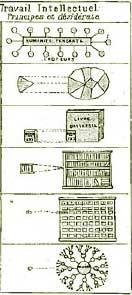
"In 1934, years before Vannevar Bush dreamed of the memex, decades before Ted Nelson coined the term “hypertext,” Paul Otlet envisioned a new kind of scholar’s workstation: a moving desk shaped like a wheel, powered by a network of hinged spokes beneath a series of moving surfaces. The machine would let users search, read and write their way through a vast mechanical database stored on millions of 3x5 index cards.

This new research environment would do more than just let users retrieve documents; it would also let them annotate the relationships between one another, “the connections each [document] has with all other [documents], forming from them what might be called the Universal Book.” Otlet imagined a day when users would access the database from great distances by means of an “electric telescope” connected through a telephone line, retrieving a facsimile image to be projected remotely on a flat screen.

In Otlet’s time, this notion of networked documents was still so novel that no one had a word to describe these relationships, until he invented one: “links.”

Read on in Boxes and Arrows: Forgotten Forefather: Paul Otlet

Keep in touch! Sign up to get updates and occasional emails from me.

08 October 2005

Saturday night fights

In tonight's main event you will fight an army of zombies.

According to the Federal Vampire and Zombie Agency (FMZA), "In ancient times zombies and vampires were frequently pitted against each other for the enjoyment of bloodthirsty spectators." So which is more formidable?

Here are some photos from a recent zombie attack.

Before the fight you might want to review the five pillars of zombie fighting:
  1. Never underestimate the zombie
  2. Never engage a zombie if you can avoid it
  3. Focus on the task; keep fear out of your head
  4. Do not allow the zombie to get a grip on you
  5. Seek medical attention after any encounter
You might also review how to survive a zombie attack and review this zombie infection simulation to ensure you are fully prepared.

Are you ready to fight?

Keep in touch! Sign up to get updates and occasional emails from me.

07 October 2005

Collaborative whiteboard

Draw. Draw collaboratively with friends or colleagues. Replay the drawing as a movie. Share the results with friends and colleagues. You can even watch me draw. Thanks to GE. Imagination Cubed.

Here's another great site called artpad, where you can draw a picture and email it to others. Watch me draw a clown on his day off.

Keep in touch! Sign up to get updates and occasional emails from me.

06 October 2005

The ultimate marriage of paper and screen

This is a pipe dream right now but I'd like to do the blue-sky thing for a minute and go on the record with an answer to the question "What does the ideal tablet PC look like?" I've carried a paper sketchbook around for 25 years or so, and so I have had plenty of time to ruminate on the subject. Here are some thoughts:

  • It's convertible. It can be used as either a laptop or straight tablet.
  • It's not too small but not too big: about the size of an 8x10 sketchbook, and very thin: no more than three-quarters of an inch thick when closed. This would make it as light and easy to carry as a sketchbook, while keeping the screen large enough to function well with most software.
  • It's tough. It should be able to survive a three-foot fall at least. Maybe the corners have bumpers?
  • The screen feels like paper. The surface should have a somwhat tactile quality, not too glasslike.
  • Handwriting recognition is flawless, or nearly so.
  • It looks cool and is functionally thoughtful. For example, it could take a cue from the Moleskine line of sketchbooks: they look distinctive and have thoughtful features like a built-in folder to hold receipts and an elastic strap to hold the book closed. Note to engineers: this is very important if you want to make millions on the product. remember that a sketchbook is an accessory as much as it is a device.
  • It has a built-in microphone that functions equally well in laptop and tablet modes.
  • It's got built-in wireless and all the standard ports.
  • Its battery lasts at least four hours without a charge.
  • It should be able to interface with the non-digital world. For example, what if it had a built-in scanner or digital camera that could function as a scanner? Then you could scan receipts, napkin-sketches or other non-digital ephemera.
What does your ideal tablet PC look like? Please share your thoughts. Maybe one of you out there will design this thing and make a few million dollars!

Keep in touch! Sign up to get updates and occasional emails from me.

05 October 2005

How to deal with an angry person

From Quick Verbal Tactics:
[A basic technique that] employs just two steps:

Step 1. A respect phrase (a statement or a question showing the other party unconditional respect). For example:
  • "I hear you. You're frustrated." [respect statement] -or-
  • "Why are you angry?" [respect question] -and-
Step 2. An outcome phrase (a statement or a question communicating a positive outcome for the other party, yourself, or the both of you). For example:
  • "I don't want you to be angry. Let's figure this thing out." [outcome statement] -or
  • "How can we achieve our goal here and minimize your frustration?" [outcome question]

Robots require only a source of energy and a series of commands to function. They're purely logical. Why are people so much more complicated? The answer can be summed up in one word: Pride."

Keep in touch! Sign up to get updates and occasional emails from me.

04 October 2005

Do you work in a passive-aggressive organization?


"Why do some organizations hum like well-oiled machines, while others stall at every intersection? In today's increasingly fast-paced race, your organization needs to shift gears quickly to succeed and grow. If it's bogged down by micromanagement, clogged information flows, and mixed motivators, it is destined to fail."

A new book called Results, by Gary L.Neilson and Bruce A. Pasternack, describes the seven types of Organizational DNA and how to optimize the performance of each:

Passive-Aggressive: Everyone agrees, but nothing changes.
Fits-and-Starts: Let 1,000 flowers bloom.
Outgrown: The good old days meet a brave new world.
Overmanaged: We're from Corporate, and we're here to help.
Just-in-Time: Succeeding by the skin of our teeth...
Military Precision: Flying in formation...
Resilient: As good as it gets...

According to the Strategy+Business Resilience Report:

"Healthy companies are hard to mistake. Their managers have access to timely information, the authority to make decisions, and the incentives to act on behalf of the organization. The organization, in turn, carries out those decisions. We call these organizations "resilient," because they can react nimbly to challenges and respond quickly to those they can't dodge.

Unfortunately, most companies are not resilient: Fewer than 20 percent of the 30,000 individuals who responded to a Booz Allen Hamilton survey describe their organizations that way. By contrast, more than a quarter of the companies in our survey suffer from a cluster of pathologies we place under the label "passive-aggressive." The passive-aggressive organization displays a quiet but tenacious resistance to corporate directives, even when they are aligned with obvious strategic or competitive advantage. People pay those directives lip service but put in only enough effort to appear compliant; and "nothing ever changes around here."

In a Harvard Business review article the authors point to three classic failings that can precipitate a spiral into passive-aggressiveness:
  1. Unclear scope of authority. It's not clear who makes decisions, leading to dropped balls and to second-guessing or interference from higher-ups.
  2. Misleading goals. Incentives that are not aligned with overall objectives -- or not aligned with other goals across the organization -- can wreak havoc and give people an opportunity to make excuses instead of making things work.
  3. Agreement without cooperation. People pay lip service to change but secretly "hope it will go away" and don't put energy and effort into making it happen.

Read the first chapter of the book.

Do you work in a passive-aggressive organization? Or is it another kind? Please leave a comment and share your observations.

Oh, and while we're on the subject of passive-aggressive behavior, check out How to use punctuation to work out your aggression. Thanks ze!

Keep in touch! Sign up to get updates and occasional emails from me.

Blogging for managers

Formerly "Use your blog as a management tool"
Blogs serve different people in different ways. The functional structure of a blog is quite flexible and can be applied in many ways; from sharing photos with friends and family to promoting your products and services.

But some of the principles that lie behind good blogging are surprisingly similar to principles of good management. Here are some of the things that good managers and good bloggers have in common:
  • They're frequent. Good managers communicate with their people, at least informally, on a daily or weekly basis; just like good bloggers.
  • They're consistent. They know who their audience is and what expertise they have to offer; and they focus their messages on things that are important to that audience.
  • They're simple and clear. They are easy to understand, and offer concepts, ideas, and "rules of thumb" that are easy to share with others. They often have a personal voice that is unique, memorable and recognizable.
  • They're personal. They use a conversational tone, and when communicating they use stories and other informal communication techniques to make issues feel more relevant.
  • They're habitual. Both good blogging and good management are behavioral; they're habits for both the sender and receivers. They happen informally and often, and are not exceptions but simply part of the natural course of business.
If you're a manager, you can use your blog as a multi-purpose management tool. Here are some of the functions your blog can serve:

  • Focusing device. I try to feed my blog with content daily. If you do the same, you'll be constantly looking for those nuggets of wisdom that might have value to your readers. They could come from anywhere: a random conversation, a billboard, a business meeting, or something your waiter said at dinner. There is a great idea to be heard every day, if you are listening.
  • Notebook. By saving your posts as drafts, you can use them as reminders for things you might want to think about or write about later. Simply writing the headline can be enough. I have many posts that are saved as drafts: it's a good way to capture an idea and keep it on your task list.
  • Management database. As a manager you often find yourself repeating things over and over as you attempt to communicate them to others. If you make the time to record that conversation once, you can re-use it countless times. When a topic comes up that you've seen before, you can simply email the link. What's more, you can continually update your blog post on any issue to reflect lessons learned over time. You can even create an index to make it easier for people to find your posts.
  • Feedback mechanism. As people comment on your posts, you'll learn how they have dealt with similar issues. You'll see what's worked for them, and discover where they agree or disagree with your thinking. Their responses can help you see how broadly your thoughts are shared (or not!), and can help you identify the strengths and weaknesses of a given approach.
  • Reference file. In your blog, you can store links to anything on the web. This is helpful because, in addition to the link, you also add your thoughts on why it's important or useful.
  • Anonymous suggestion box. If you allow anonymous comments, your peers and employees can post to your blog anonymously without fear. This can get you valuable feedback on your management approach and how it's perceived.
  • Endorsement. Often, as people comment on your thoughts they will endorse the ideas, or tell you how it works in their world. Now, when you email a link, it's not just you talking: your thoughts will gain stature and credibility with your team, when they see that others agree.

A recent thread with Roland Jones got me thinking about this. Roland, who just started his blog, compared it to a brand new Moleskine sketchbook. To me it's a bit different --I don't think of my blog sequentially, but more like a set of index cards, where each blog post stores a single, cohesive thought.

Along the "index cards" line of thinking, I wish there was a link you could add to your blog that allowed readers to do a "random shuffle" of the blog's contents.

How do you think of your blog? Do you use it as a management tool? If so please share your thoughts.

Keep in touch! Sign up to get updates and occasional emails from me.

03 October 2005

Index to blog entries

A lot of you have asked for this, so I created an index to Communication Nation blog entries. It's open to the public, so I welcome you to add links to blog posts that relate to the Communication Nation mission:

"Communication is one of the most important skills anyone can have, in business and in life. As individuals and as a species, I believe we will be happier and more productive if we can improve our ability to communicate. This blog is dedicated to that effort."

I've also added a link to the index in the sidebar, right below the Google site search.

Keep in touch! Sign up to get updates and occasional emails from me.

02 October 2005

Information overload in the office

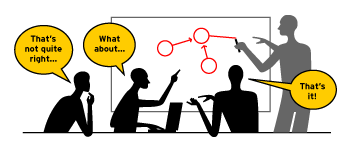
Does this scene look familiar? What are these people saying?

I'm having a contest to see who can write the best words/caption for this picture.

If you win you can choose between two prizes: a free copy of my book, Selling to the VP of NO, or a free deck of Discovery Cards. What are Discovery Cards? If you win, you'll find out!

If you comment on this post I'll consider it a submission.

Updating this on Monday 3 October: Check out some of the responses, they're a riot -- d

Keep in touch! Sign up to get updates and occasional emails from me.

01 October 2005

Saturday night fights

This Saturday I want to introduce you to something from the Digital Media Collaboratory (DMC) of the Innovation Creativity and Capital Institute (IC2) at the University of Texas.

The screenshot shown here is from Project NERO, an exploration into artificial intelligence, training, learning and teaching, and although it's a game, it also offers insights into how machines can be designed to learn. It also has implications for the way we learn and teach in the real world.

NERO stands for stands for Neuro-Evolving Robotic Operatives. As a player, you train your army of robots to fight in various terrains and against various opponents. You set goals for them by rewarding and punishing various behaviors, and the robots learn Darwin-style: those that achieve the goals are allowed to reproduce, and those that do not, die out.

The system tracks the evolution of species, complexity of neural networks and various other factors. Be warned: it's addictive! I got fully sucked in and wasted an entire day on this yesterday, developing various armies with different specialties. Here are the names of the armies I developed yesterday:
- Assault troops: Shock troops with no fear or regard for their own lives
- Hunters: Rapidly search an area and kill anythng they find
- Searchers: Trained for combat in maze-like environments
- Survivors: Soldiers who disperse, hide and preserve their own skins, killing enemies when they can
- Swarm: Stick together in a "hive" and swarm around any opponent

NERObots have some lessons for how to teach in the real world:
- Teach one thing at a time. NERObots get confused when confronted with multiple learning objectives simultaneously. You have to work with them till one habit or behavior is firmly instilled and then build on that.
- There's no substitute for practice. You train your NERObots in a sandbox and then deploy them in real-life battles. The more they train, the stronger they get.
- Good training requires a plan. To be successful with NERObots, you need to set clear criteria for success, and build your training plan so one learning objective builds on the next.
- Unleash creativity for the best results. If you set up a structured "learning environment" and clear learning objectives without prescribing solutions, NERObots will discover things you might never have taught them: my NERObots achieved many of their goals in ways I did not anticipate.

Unfortunately for you Mac users out there, NERO is not available for Macs. But if you have a PC, you can download NERO for free and try it yourself.

Keep in touch! Sign up to get updates and occasional emails from me.

A Google exec explains how to get his attention

Chris Sacca of Google:

"As one of Google's Principals for New Business Development, I am on the front line of inbound business proposals. I would gather I see 40-50 per day. The launch of Google Talk has probably added another 15-20 per day.

So, as I sit with trepidation considering how many emails I have flagged for follow-up in my inbox on this Sunday afternoon, I thought I would take a minute to type out some hints that will make it easier on both of us and increase the likelihood that your company and mine will get some business done. "

Thanks, bblog!

Keep in touch! Sign up to get updates and occasional emails from me.

30 September 2005

Demographic mapping

Get demographic information for any location by pointing to it on a map. By default the map is focused on the LA area, but you can view other areas by zooming out and panning around.

Keep in touch! Sign up to get updates and occasional emails from me.